
Magnesium Complex 1000mg – Heart, Brain & Kidney Support
Explore our Magnesium Complex 1000mg guide. Learn how Magnesium citrate and malate support heart health, nervous system function, and kidney health.
Magnesium Complex 1000mg: What It Is and Why It Matters
Magnesium is the fourth most abundant cation in the human body and a critical cofactor in more than 300 enzyme systems that regulate energy metabolism, neuromuscular function, cardiovascular health, bone integrity, and psychological well-being. Despite its importance, emerging evidence confirms that nearly two-thirds of the population in the western world is not achieving the recommended daily allowance for Magnesium — a deficiency problem contributing to various health conditions.
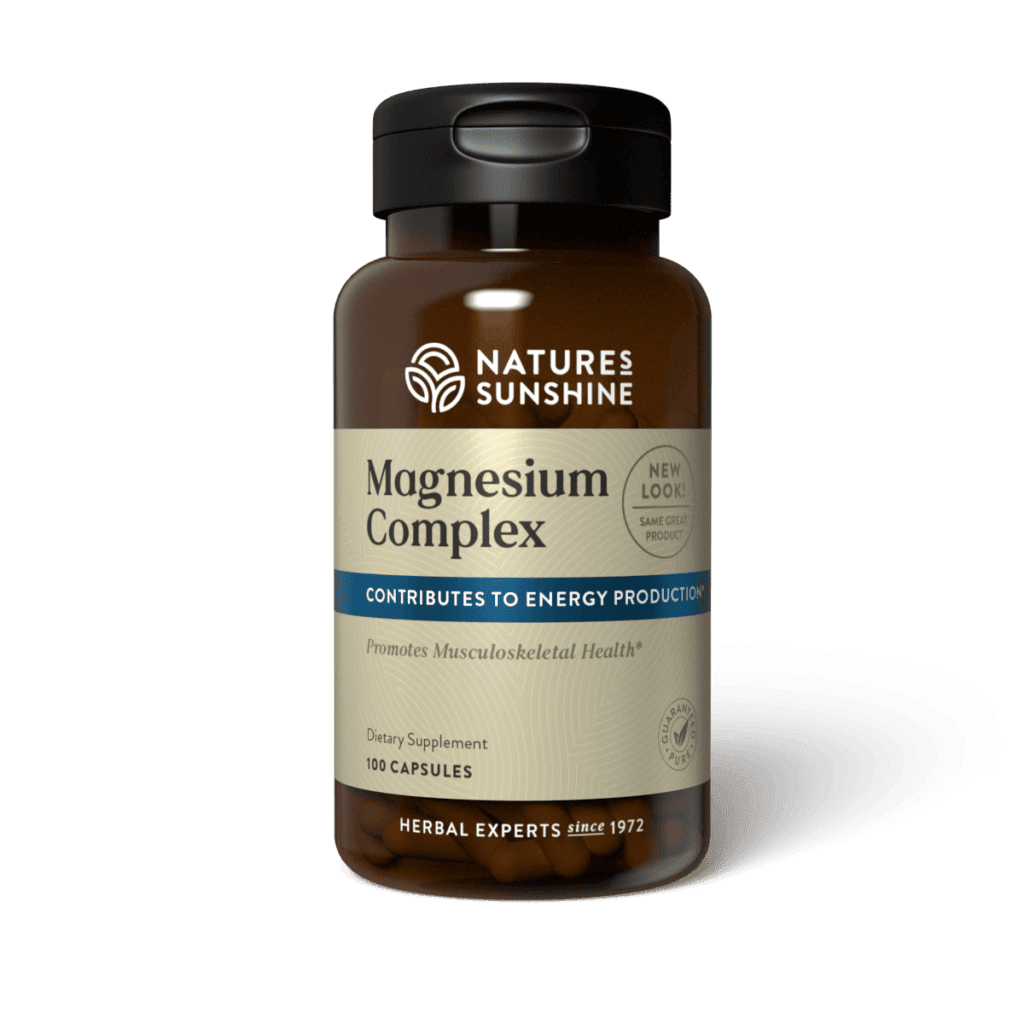
Nature's Sunshine Magnesium Complex delivers this essential mineral in two highly soluble organic forms — Magnesium citrate and Magnesium malate — chosen specifically for optimum effectiveness. Organic forms of Magnesium are generally more soluble and have higher bioavailability than inorganic forms such as Magnesium oxide. In fact, research shows Magnesium citrate had high solubility even in water (55%) and was substantially more soluble than Magnesium oxide in all states of acid secretion.
This Magnesium Complex 1000mg formula is designed to support the cardiovascular system, brain and nervous system function, and kidney health. Two capsules provide 184 mg of Magnesium, and the recommended daily serving of four capsules provides a meaningful contribution toward the RDA of 400–420 mg/day for adult men and 310–320 mg/day for adult women.
If you have questions about whether a Magnesium Complex 1000mg supplement is appropriate for your personal health goals, our naturopath is available for a free consultation to help guide your decision.
Two Bioavailable Forms Working Together
Not all Magnesium supplements are created equal. The form in which Magnesium is delivered has a direct impact on how well your body absorbs and uses it. Nature's Sunshine Magnesium Complex pairs two organic forms — citrate and malate — that are both recognized for their superior solubility compared to common inorganic alternatives.
Why Citrate and Malate?
Magnesium citrate is one of the most bioavailable forms available, with research demonstrating high solubility in water that leads to efficient absorption. Magnesium malate is another well-regarded organic form, chelated to malic acid. These organic forms involve Magnesium bound to organic molecules, and they are generally more soluble and have higher bioavailability than inorganic forms such as Magnesium oxide, sulfate, or chloride.
The Mg²⁺ Ion at Work
Once absorbed, the biological activity of Magnesium resides in the Mg²⁺ ion itself. It serves as an indispensable cofactor for ATP synthesis — the energy currency of every cell — by playing a pivotal role in transition state formation during ATP synthesis catalyzed by ATP synthases. Magnesium is also required for energy production, oxidative phosphorylation, and glycolysis.
Beyond energy production, Mg²⁺ is an essential cofactor for Na,K-ATPase activation, regulating ion transport across cell membranes. It modulates neuronal excitability through voltage-gated calcium antagonism and NMDA receptor blockade. And it participates in protein synthesis, muscle and nerve function, blood glucose control, and blood pressure regulation.
Key Ingredients
- ✓ Free shipping on all orders
- ✓ 90-day easy returns
- ✓ Ships within hours
Who May Benefit from Magnesium Complex 1000mg
Because Magnesium plays such a wide-ranging role in the body, a Magnesium Complex 1000mg supplement may be especially relevant for several groups of people. It is estimated that between 56 and 68% of Americans do not obtain enough Magnesium in their diet on a daily basis to meet the recommended daily allowance.
Adults Focused on Heart Health
Research consistently associates higher Magnesium levels with a lower risk of cardiovascular concerns. In 2022, the U.S. FDA approved a qualified health claim stating that consuming diets with adequate Magnesium may reduce the risk of high blood pressure, though it characterized the evidence as inconsistent and inconclusive. If cardiovascular support is a priority for you, this formula's highly soluble forms may help you maintain adequate Magnesium status.
Those Concerned About Kidney Health
The kidneys are the primary regulators of whole-body Magnesium homeostasis, and research suggests that adequate Magnesium intake may support healthy urinary mineral balance. A landmark RCT found that potassium-Magnesium citrate supplementation significantly reduced kidney stone recurrence compared to placebo.
Older Adults
As we age, Magnesium absorption and retention can decrease. Older adults are more susceptible to Magnesium deficiency due to decreased absorption from food, increased medication use (diuretics can deplete Magnesium), and potential dietary restrictions. Men older than 70 and teenage girls are most likely to have low intakes.
People Taking Certain Medications
Several common medications, including loop and thiazide diuretics and proton pump inhibitors (PPIs) taken long-term, can cause Magnesium loss and contribute to deficiency. Individuals with type 2 diabetes and those with gastrointestinal disorders are also at elevated risk of inadequate Magnesium status.
If you're unsure whether supplemental Magnesium is right for your situation, our naturopath offers free consultations to help you make an informed choice.
How to Take Magnesium Complex
Take 2 capsules twice daily with a meal. Each serving of 2 capsules provides 184 mg of Magnesium from a combination of Magnesium citrate and Magnesium malate.
Important Safety Notes
Magnesium supplements can cause nausea, cramps, and diarrhea, especially at higher doses. Side effects are more common with inorganic forms like Magnesium oxide; the organic citrate and malate forms in this complex are generally better tolerated.
Be aware of potential drug interactions. Magnesium may decrease absorption of bisphosphonates (separate by at least 2 hours), tetracycline and quinolone antibiotics (take antibiotics at least 2 hours before or 4–6 hours after Magnesium), and gabapentin (absorption may be reduced by 20%). If you take loop or thiazide diuretics, be aware they can deplete Magnesium. If you take proton pump inhibitors long-term, the FDA advises healthcare professionals to consider monitoring serum Magnesium levels.
Hypermagnesemia from supplemental intake is rare in individuals with normal kidney function because the kidneys efficiently excrete excess Magnesium. Risk is substantially elevated in individuals with impaired renal function. Always consult your healthcare provider before starting any new supplement, especially if you are pregnant, nursing, taking medications, or have a medical condition.
Written by Greg Howlett
Frequently asked questions
How much Magnesium does each serving of Magnesium Complex provide?
Each serving of 2 capsules provides 184 mg of Magnesium from two organic forms: Magnesium citrate and Magnesium malate. The recommended daily intake is 2 capsules twice daily with a meal, for a total of 4 capsules per day.
Why does this formula use citrate and malate instead of Magnesium oxide?
Magnesium citrate and Magnesium malate are organic forms of Magnesium that are generally more soluble and have higher bioavailability than inorganic forms. Research shows Magnesium citrate had high solubility even in water (55%) and was substantially more soluble than Magnesium oxide in all states of acid secretion. Magnesium oxide was virtually insoluble in water and only 43% soluble in simulated peak acid secretion.
Can Magnesium supplements interact with medications?
Yes. Magnesium can decrease absorption of bisphosphonates (separate by at least 2 hours), form insoluble complexes with tetracycline and quinolone antibiotics (take the antibiotic at least 2 hours before or 4–6 hours after Magnesium), and may reduce gabapentin absorption by 20%. Loop and thiazide diuretics can deplete Magnesium, while long-term use of proton pump inhibitors (PPIs) can cause hypomagnesemia. Consult your healthcare provider if you take any of these medications.
How does Magnesium support heart health?
Research suggests Magnesium supports the cardiovascular system in multiple ways. It regulates cardiac ion channels, myocardial conduction, and contraction. Large meta-analyses and prospective cohort studies consistently associate higher Magnesium levels with lower risks of coronary heart disease, atrial fibrillation, and heart failure. Magnesium supplementation has also been shown in multiple RCTs and meta-analyses to modestly but significantly reduce blood pressure, particularly in Magnesium-deficient or hypertensive individuals.
Is Magnesium deficiency common?
Yes. It is estimated that between 56 and 68% of Americans do not obtain enough Magnesium in their daily diet to meet the recommended daily allowance. Men older than 70 and teenage girls are most likely to have low intakes. Older adults are especially susceptible due to decreased absorption from food, increased medication use, and dietary restrictions. Early signs of deficiency include loss of appetite, nausea, fatigue, and weakness; more severe deficiency can lead to numbness, muscle cramps, abnormal heart rhythms, and coronary spasms.
How does Magnesium support kidney health?
The kidneys are the primary site of Magnesium excretion and the major regulator of whole-body Magnesium homeostasis. Research suggests Magnesium is a well-established inhibitor of calcium oxalate crystallization in urine. A landmark double-blind RCT found that potassium-Magnesium citrate supplementation resulted in new stones forming in only 12.9% of treated subjects versus 63.6% on placebo. Magnesium supplementation also reduces urinary oxalate excretion and raises urinary citrate, both key protective factors against stone formation.
Talk to Dr. Shannyn Fowl
Not sure if this is right for you? Book a free, no-pressure consultation for personalized guidance on your health goals.
Book your free consult →About Caring Sunshine
A family-run reseller of premium supplements — free shipping, a 90-day guarantee, and real people who know the products.
Learn more about us →