
How Much Collagen Per Day | Dosage Guide
Learn how much Collagen per day you should take. Explore clinical dosages, key benefits for skin, joints & more, plus tips on daily use from our guide.
How Much Collagen Per Day: What the Research Actually Says
Collagen is the single most abundant protein in the human body, comprising approximately one-third of total proteins. It forms the structural foundation of skin, hair, nails, bones, cartilage, tendons, ligaments, and even the lining of the gastrointestinal tract. Understanding how much Collagen per day to take matters because this fibrous protein — rich in glycine, proline, and hydroxyproline — naturally declines with age, and that decline is closely linked to reduced skin elasticity, joint stiffness, and weakened connective tissue.
Modern Collagen supplements use hydrolyzed Collagen (also called Collagen peptides), which breaks the large Collagen polymer into smaller peptide chains of roughly 3–6 kDa. Studies have shown that when Collagen hydrolysate is taken orally, it is absorbed as di- and tripeptides typically rich in hydroxyproline. These smaller peptides are believed to enter circulation and reach target tissues like skin or cartilage, where they may help support Collagen-producing cells called fibroblasts.
The tradition of consuming Collagen-rich foods — bone broths, slow-simmered stocks, chicken feet, and pork trotters — stretches back centuries across virtually every culture. The convenience of a modern powder that dissolves in a beverage is simply the contemporary contribution to a practice that has been part of human nutrition for millennia.
How Much Collagen Per Day Based on Clinical Research
One of the most common questions we hear — often during our free naturopathic consultations — is exactly how much Collagen per day someone should take. While optimal dosing regimens have not yet been definitively established by the available clinical literature, the research does offer helpful ranges organized by area of use.
Skin Health (Hydration, Elasticity, Anti-Aging)
Clinical studies have used Collagen tripeptide at 3 g/day for 4 to 12 weeks, with notable improvement in skin elasticity and hydration. Multiple meta-analyses of RCTs — including one analyzing up to 26 RCTs with 1,721 participants — demonstrate significant improvements in skin elasticity and hydration after 8–12 weeks at doses of 1–10 g/day. A 12-week RCT using 1,000 mg/day showed significantly higher skin hydration values versus placebo at both 6 and 12 weeks.
Joint Pain and Exercise Recovery
Research suggests that 5–15 g/day of Collagen peptides, when taken at least 1 hour prior to exercise for over 3 months, may aid in reducing functional joint pain and improving muscle recovery. The beneficial effects of Collagen supplementation appear to take effect after three months or longer.
Cellulite
One double-blind, placebo-controlled RCT of 105 women used 2.5 g/day of bioactive Collagen peptides for 6 months, showing statistically significant improvement in cellulite with improved dermal density and reduced skin waviness.
Nail Strength
A 2017 open-label trial found that 2.5 g/day of specific bioactive Collagen peptides for 24 weeks increased nail growth rate by 12% and reduced the frequency of broken nails by 42% in women with brittle nail syndrome.
General Safety
Prolonged use of Collagen is deemed to be safe. None of the studies within one systematic review reported any adverse effects of Collagen supplementation, even at higher doses of 60 g/day or in different supplement forms. The FDA classifies hydrolyzed Collagen as "Generally Recognized as Safe" (GRAS).
If you're unsure how much Collagen per day is right for your particular goals, our naturopath is available for a free consultation to help you find the right fit.
Key Ingredients
- ✓ Free shipping over $75
- ✓ 90-day easy returns
- ✓ Ships within hours
Who Should Consider Daily Collagen Supplementation
Because Collagen supports such a wide array of structural tissues, daily supplementation may be relevant for a broad range of people. Skin aging is accompanied by declining Collagen content, characterized by decreases in Collagen, elastin fiber, and hyaluronic acid levels — resulting in loss of skin elasticity and hydration. Anyone interested in promoting a more youthful appearance may find Collagen peptides worth exploring.
Active individuals and athletes may also benefit. Research suggests that Collagen peptide supplementation in conjunction with exercise may be beneficial for the management of degenerative bone and joint disorders, improving structure and load-bearing capabilities. A systematic review of 15 RCTs found that Collagen supplementation increased pain-free time to exertion and Collagen synthesis in athletes.
Preliminary research in postmenopausal women with osteopenia suggests Collagen supplementation may support bone strength, density, and mass — though larger studies are needed. Similarly, those concerned about nail brittleness, hair appearance, or connective tissue integrity may find value in daily Collagen use.
It's worth noting that Collagen is an incomplete protein — it lacks the essential amino acid tryptophan and should not be used as a sole protein source. For personalized guidance on how much Collagen per day makes sense for your individual situation, our naturopath offers free consultations.
How to Take Collagen Peptides Every Day
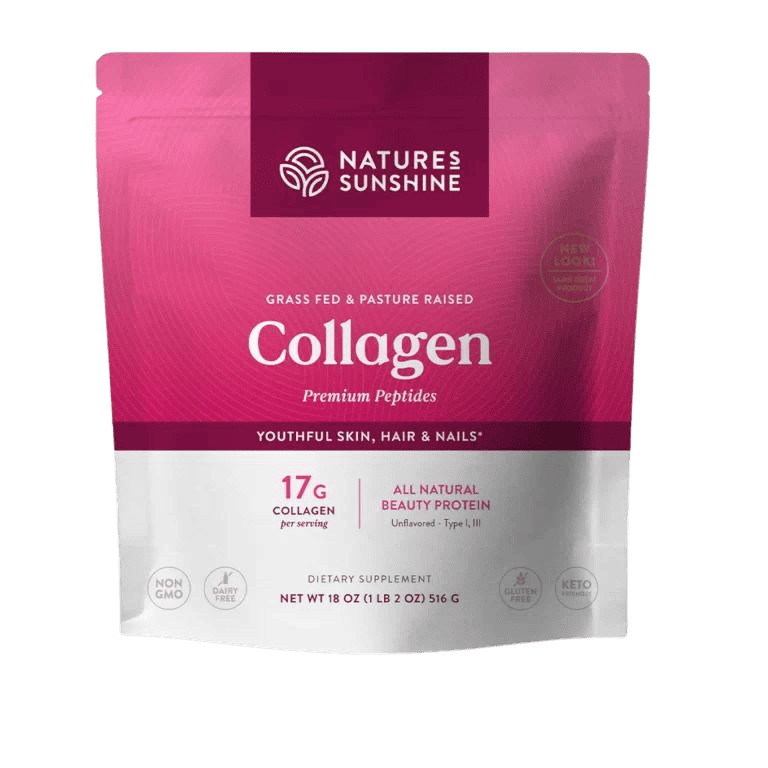
Nature's Sunshine's Collagen peptides are odorless, tasteless, and mix easily into any hot or cold beverage, smoothie, or food. Stir 1 scoop into any beverage — coffee, tea, water, fruit juice, or others — or add it to your favorite recipes. Use daily for best results.
This formula is NON-GMO, KETO-friendly, DAIRY-free, GLUTEN-free, and PALEO-friendly, making it easy to integrate into a wide range of dietary approaches. The product also includes electrolytes and trace minerals to complement your active lifestyle.
Because the requirement for vitamin C as a cofactor in Collagen synthesis is well established, emerging data suggest that co-supplementation with vitamin C may further support the body's use of Collagen peptides. Consistency matters too — clinical benefits in studies typically appeared after 8–12 weeks of daily use, and for joint-related outcomes, benefits appeared after three months or longer.
Choosing a Quality Collagen Supplement
Not all Collagen supplements are created equal. A prominent study evaluating popular Collagen supplement brands in the US found that 64% tested positive for measurable levels of arsenic, 37% for lead, 34% for trace levels of mercury, and 17% for measurable levels of cadmium — with some exceeding regulatory thresholds. This underscores the importance of choosing a supplement from a source you trust.
Nature's Sunshine's premium Collagen peptides are certified non-GMO, gluten-free, dairy-free, soy-free, Keto-friendly, and Paleo-friendly. The primary commercial sources of Collagen include bovine hide and bone, porcine hide and bone, chicken sternal cartilage, and fish skin and scales. Individuals with known allergies to specific animal sources should review sourcing carefully — people allergic to fish, for example, may develop reactions when consuming marine-derived Collagen.
Overall, prolonged use of Collagen is deemed safe across the literature, and the FDA classifies hydrolyzed Collagen as Generally Recognized as Safe (GRAS). If you have questions about sourcing or whether Collagen is right for you, our naturopath is happy to help during a free consultation.
Written by Greg Howlett
Frequently asked questions
How much Collagen per day is supported by research?
Clinical studies have used a range of dosages depending on the goal. For skin health, studies have used 1–10 g/day (with some using Collagen tripeptide at 3 g/day) for 4–12 weeks. For joint pain and exercise recovery, research suggests 5–15 g/day taken at least 1 hour before exercise for over 3 months. For nail strength and cellulite, studies have used 2.5 g/day for 24 weeks and 6 months respectively. Optimal dosing regimens have not yet been definitively established across all indications.
Is Collagen safe for long-term daily use?
Prolonged use of Collagen is deemed to be safe. None of the studies within one systematic review reported any adverse effects of Collagen supplementation, even at higher doses of 60 g/day or in different supplement forms. The FDA classifies hydrolyzed Collagen as Generally Recognized as Safe (GRAS). However, individuals with allergies to specific animal sources (such as fish or shellfish) should exercise caution with marine-derived Collagen.
What does Collagen do for skin, hair, and nails?
Research suggests oral Collagen peptides may support skin hydration and elasticity — a meta-analysis of 10 RCTs found statistically significant improvements in both. Studies also indicate Collagen may promote decreased wrinkle formation, increased Collagen density, and improved dermal hydration. For nails, one trial found 2.5 g/day of bioactive Collagen peptides increased nail growth rate by 12% and reduced broken nails by 42%. Collagen peptides also provide amino acid substrates like proline and glycine that support keratin synthesis relevant to hair, though clinical evidence for hair specifically remains limited.
Can Collagen help with joint pain?
Research suggests it may. A systematic review and meta-analysis concluded there is compelling evidence of significant pain reduction in knee osteoarthritis patients who received Collagen peptides compared to placebo. For athletes, a systematic review of 15 RCTs found Collagen supplementation increased pain-free time to exertion. One systematic review concluded Collagen supplementation is strongly indicated for its positive therapeutic effect on pain management of osteoarthritis. Benefits appear to take effect after three months or longer of consistent use.
Is Collagen a complete protein?
No. Collagen is an incomplete protein because it lacks the essential amino acid tryptophan. While it provides a distinctive amino acid profile rich in glycine, proline, and hydroxyproline, it should not be used as a sole protein source. For muscle protein synthesis specifically, other higher quality protein sources such as whey protein may be more beneficial.
How should I take Collagen peptides?
Nature's Sunshine Collagen peptides are odorless, tasteless, and mix easily into any hot or cold beverage, smoothie, or food. Stir 1 scoop into coffee, tea, water, fruit juice, or other beverages, or add it to your favorite recipes. Use daily for best results. The formula is NON-GMO, KETO-friendly, DAIRY-free, GLUTEN-free, and PALEO-friendly.
Talk to Dr. Shannyn Fowl
Not sure if this is right for you? Book a free, no-pressure consultation for personalized guidance on your health goals.
Book your free consult →About Caring Sunshine
A family-run reseller of premium supplements — free shipping, a 90-day guarantee, and real people who know the products.
Learn more about us →