
How Much Vitamin C Should I Take Daily? A Complete Guide
Learn how much Vitamin C should I take daily, what the RDA is, and how time-release Vitamin C with bioflavonoids supports immunity and antioxidant defense.
How Much Vitamin C Should I Take Daily?
If you've ever asked yourself how much Vitamin C should I take daily, you're not alone — it's one of the most common questions in nutritional health. Vitamin C (ascorbic acid) is a water-soluble nutrient the body cannot produce on its own due to a genetic mutation in the L-gulonolactone oxidase (GLO) gene. That means every milligram must come from food or supplementation.
Vitamin C is far more than an immune booster. It serves as a potent antioxidant, a cofactor for collagen biosynthesis, a contributor to carnitine and catecholamine metabolism, and an enhancer of dietary iron absorption. It supports epithelial barrier function, promotes the oxidant-scavenging activity of the skin, and plays essential roles in both innate and adaptive immunity.
Because the body cannot store large amounts of this vitamin — and because absorption efficiency drops at higher doses — understanding the right daily intake matters. Let's walk through what the research says.
RDA, Upper Limits, and What Science Recommends
The Recommended Dietary Allowance (RDA) for Vitamin C, established by the U.S. federal government, is 90 mg/day for adult men and 75 mg/day for adult women. These amounts are set to maintain near-maximal neutrophil concentration with minimal urinary excretion of ascorbate. Pregnant women are advised to increase intake to 85 mg/day, and lactating women to 120 mg/day. Smokers should add an extra 35 mg/day regardless of sex.
For infants and children, the RDA ranges from 15 to 115 mg depending on age. According to NHANES data, mean intakes from food and beverages are approximately 105 mg/day for adult males and 84 mg/day for adult females, meeting the RDA for most nonsmoking adults.
The Tolerable Upper Intake Level (UL) is set at 2,000 mg/day for adults — more than twenty times the RDA — to help prevent gastrointestinal discomfort and diarrhea, which are the only consistently documented side effects of high-dose Vitamin C. Amounts above 1 g/day see absorption efficiency fall to roughly 50% or less, since intestinal absorption is saturable and dose-dependent.
A plasma level of 50 µmol/L is widely considered the threshold for adequacy, while levels below 23 µmol/L indicate clinical deficiency (hypovitaminosis C). If you're unsure where you fall, our naturopath is available for a free consultation to help you think through your individual needs.
Immune Support, Antioxidant Defense, and Collagen Production
Research consistently shows that Vitamin C contributes to immune defense by supporting epithelial barrier function against pathogens, enhancing the differentiation and proliferation of B cells and T cells, promoting phagocytosis, normalizing cytokine production, and decreasing histamine levels. Plasma concentrations decline rapidly during viral infections, underscoring the body's increased demand during immune challenges.
As an antioxidant, Vitamin C directly scavenges reactive oxygen species in aqueous cellular compartments and plasma, and it regenerates the antioxidant form of vitamin E at membrane interfaces. Multiple human trials demonstrate that supplementation raises antioxidant capacity and reduces biomarkers of oxidative damage.
Vitamin C is also essential for proper folding and deposition of collagen proteins — the most abundant proteins in the human body. Without adequate Vitamin C, prolyl and lysyl hydroxylase enzymes cannot properly hydroxylate collagen precursors, leading to structurally defective collagen. This is the biochemical basis of scurvy's hallmark connective-tissue breakdown.
Additionally, Vitamin C enhances the absorption of non-heme iron by reducing ferric iron (Fe³⁺) to ferrous iron (Fe²⁺) in the gastrointestinal lumen — a form more readily absorbed by intestinal cells. It is also involved in the production of adrenal steroids and catecholamines, and in the metabolism of amino acids and cholesterol.
Who Benefits from a 1,000 mg Time-Release Vitamin C
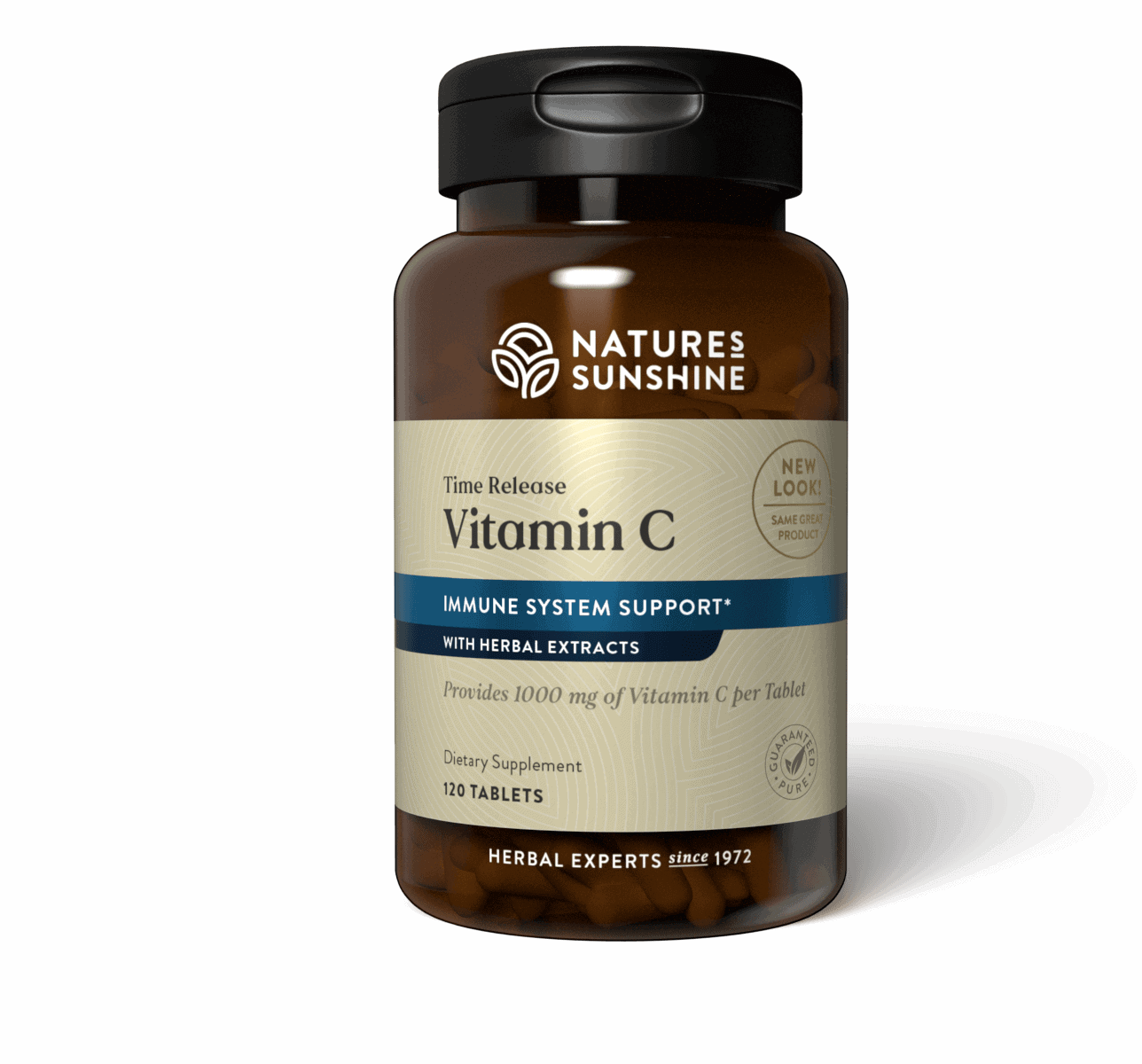
Because Vitamin C is water-soluble and absorption drops sharply above 1 g/day, a time-release delivery format can help the body utilize a higher dose more effectively. Nature's Sunshine Vitamin C Time Release features a special coating that slows nutrient absorption until the tablet reaches the intestines, providing all-day support rather than a single spike followed by rapid excretion.
This formulation is well-suited for adults looking to support their immune system, fight free radicals, nourish tissues, and assist in the production of collagen. It is vegan and non-GMO, with no sugar, starch, artificial colorings, or flavorings.
A Cochrane review of 29 trials involving over 11,000 participants found that while regular Vitamin C supplementation does not prevent colds in the general population, it modestly reduces cold duration — by about 8% in adults and 14% in children — and may reduce severity. The benefit is more pronounced in people under severe physical stress, such as marathon runners and military personnel. Research also supports Vitamin C's role in respiratory health, with clinical evidence showing supplementation at 400 mg/day or more may support lung function.
For those navigating seasonal immune challenges, post-illness recovery, or simply wanting daily antioxidant protection, this formula provides meaningful support grounded in science.
Key ingredients
- ✓ Free shipping over $75
- ✓ 90-day easy returns
- ✓ Ships within hours
How to Take Vitamin C Time Release
Take one tablet daily with a meal. Taking Vitamin C with food supports absorption and reduces the likelihood of gastrointestinal discomfort. The time-release coating is designed to slow nutrient release until the tablet reaches the intestines, helping sustain Vitamin C levels throughout the day rather than producing a single peak followed by rapid urinary excretion.
Because 70–90% of usual dietary intakes (30–180 mg/day) are absorbed efficiently, and absorption falls to about 50% or less above 1 g/day, the time-release format helps the body make the most of each tablet.
Written by Greg Howlett
Frequently asked questions
How much Vitamin C should I take daily according to the RDA?
The RDA is 90 mg/day for adult men and 75 mg/day for adult women. Pregnant women are advised to consume 85 mg/day, lactating women 120 mg/day, and smokers should add 35 mg/day to their recommended intake regardless of sex. For infants and children, the RDA ranges from 15 to 115 mg depending on age.
Can I take too much Vitamin C?
The Tolerable Upper Intake Level for adults is 2,000 mg/day. The only consistently documented side effects of high-dose Vitamin C are gastrointestinal upset, diarrhea, stomach cramps, and bloating. At very high doses, elevated urinary oxalate excretion has been reported, which may raise concerns about kidney stones in susceptible individuals. Serious side effects are very rare because the body cannot store excess Vitamin C.
Does Vitamin C prevent the common cold?
A Cochrane review of 29 trials involving over 11,000 participants found that regular Vitamin C supplementation does not reduce the incidence of colds in the general population. However, it modestly reduces cold duration — by about 8% in adults and 14% in children — and may lessen severity. The benefit is more pronounced in people under severe physical stress, such as marathon runners and military personnel. Taking Vitamin C after cold symptoms have already started does not appear to be helpful.
Why choose a time-release Vitamin C formula?
Vitamin C is water-soluble and absorption efficiency drops to about 50% or less at doses above 1 g/day. A time-release tablet features a special coating that slows nutrient absorption until the tablet reaches the intestines, helping sustain Vitamin C levels throughout the day rather than producing a single spike followed by rapid excretion.
What are the bioflavonoids in this formula and why are they included?
This formula is blended with Rose hips extract, acerola extract, Rutin, Lemon bioflavonoids, and Hesperidin complex. These plant-derived compounds provide additional antioxidant support and work synergistically with Vitamin C. Research shows that Rutin and Hesperidin modulate inflammatory pathways and support immune function, while Rose hips and Lemon bioflavonoids are natural sources of complementary antioxidants and flavonoids.
Who should be cautious with Vitamin C supplements?
People with hemochromatosis should avoid high-dose Vitamin C because it enhances iron absorption. Those with G6PD deficiency should not take high doses due to a risk of hemolysis. Large doses are not recommended during pregnancy, and people with a history of kidney stones should consult a healthcare professional. Vitamin C may also interact with chemotherapy drugs, statins combined with niacin, estrogen-containing medications, and protease inhibitors. Our naturopath is available for a free consultation if you have questions about your specific situation.
Talk to Dr. Shannyn Fowl
Not sure if this is right for you? Book a free, no-pressure consultation for personalized guidance on your health goals.
Book your free consult →About Caring Sunshine
A family-run reseller of premium supplements — free shipping, a 90-day guarantee, and real people who know the products.
Learn more about us →