
Can I Take 5000 IU of Vitamin D3 Everyday?
Can I take 5000 IU of Vitamin D3 everyday? Learn what the research says about daily Vitamin D3 dosing, safety considerations, and who may benefit most.
Can I Take 5000 IU of Vitamin D3 Everyday?
It's one of the most common supplement questions we hear: can I take 5000 IU of Vitamin D3 everyday? With so many people spending more time indoors and living in climates with limited sunshine, it's a fair question — and the answer involves understanding what Vitamin D3 is, how your body uses it, and what the research says about daily dosing.
Vitamin D3, also called cholecalciferol, is a fat-soluble secosteroid that your skin naturally produces when UVB rays (approximately 290–320 nm wavelength) convert 7-dehydrocholesterol into previtamin D3. However, factors like season, cloud cover, time of day, skin melanin content, sunscreen use, aging, and smog all reduce your skin's ability to manufacture it. For many people, supplementation may be necessary to maintain adequate levels — especially during cloudy months or winter.
According to the NIH Office of Dietary Supplements, most people in the United States consume less than the recommended amounts of vitamin D. Serum 25-hydroxyvitamin D — the form measured in blood tests — is the main indicator of vitamin D status. The Institute of Medicine considers a minimum concentration of 20 ng/mL (50 nmol/L) as physiologically adequate for at least 97.5% of the population, though values below 20 ng/mL indicate deficiency and levels between 20–30 ng/mL suggest insufficiency.
What Studies Say About Daily Vitamin D3 Dosing
To understand whether 5,000 IU daily is appropriate, it helps to look at the dosing landscape. The Institute of Medicine's RDA is 600 IU/day for adults up to age 70 and 800 IU/day for those over 70. The Tolerable Upper Intake Level (UL) — defined as the highest daily intake unlikely to cause adverse health effects — is set at 4,000 IU/day (100 mcg/day) for children aged 9 and older and adults.
That means 5,000 IU per day exceeds the established UL by 1,000 IU. However, the UL is not a ceiling that triggers immediate harm — it is the level above which the risk for adverse effects begins to increase. Multiple clinical trials have studied daily doses at and above this level. The VITAL trial administered 2,000 IU/day to over 25,871 participants for a median of 5.3 years. The Finnish Vitamin D Trial (FIND) studied arms at 1,600 IU/day and 3,200 IU/day over five years. Maintenance dosing studies using 50,000 IU weekly (roughly 7,143 IU/day equivalent) have sustained serum 25(OH)D concentrations in the 40–60 ng/mL range with no evidence of toxicity.
Vitamin D3 could be more than three times as effective as vitamin D2 in raising serum 25(OH)D concentrations and maintaining those levels for a longer time, and its metabolites have superior affinity for vitamin D-binding proteins in plasma. This makes D3 the preferred supplemental form.
Still, it's important to note that very high blood levels of vitamin D (greater than 375 nmol/L or 150 ng/mL) can cause nausea, vomiting, muscle weakness, confusion, kidney stones, and, in severe cases, kidney failure or cardiac arrhythmias. Toxicity is almost always caused by excessive supplement intake — you cannot get too much vitamin D from sunshine. If you're wondering whether a daily 5,000 IU dose is right for you, our naturopath is available for a free consultation to help you think through your individual situation.
How Vitamin D3 Supports Your Body
Vitamin D3 as ingested or synthesized in the skin is biologically inert. It requires two sequential hydroxylation steps — first in the liver (producing 25-hydroxyvitamin D, the circulating marker form) and then in the kidneys (producing calcitriol, the active hormonal form) — before it can exert its wide-ranging effects through vitamin D receptor (VDR)-mediated pathways found in virtually every organ system.
Bone and Structural Health
Vitamin D3 plays a crucial role in improving Calcium absorption, modulating bone remodeling, and supporting muscle function. It helps regulate normal blood levels of Calcium and phosphorus and assists in strengthening bones through mineralization. Research supports its established clinical role in preventing rickets and osteomalacia, and combined supplementation with Calcium has been shown to attenuate bone loss in older adults.
Immune Health
Vitamin D3 has several established roles in immunomodulation. It induces the expression of antimicrobial peptides — including cathelicidin and β-defensins — with broad-spectrum activity against bacteria, viruses, and fungi. These peptides are important for the clearance of infections and maintaining the integrity of the respiratory tract, skin, and gut mucosa. A 2017 meta-analysis of 25 randomized controlled trials revealed a protective effect of vitamin D supplementation against acute respiratory infections. Upon conversion to calcitriol, Vitamin D3 directs adaptive immunity by adjusting T and B cell function and favors the differentiation of regulatory T cells critical for maintaining immune tolerance.
Cardiovascular System
Observational studies and meta-analyses have consistently reported associations between low serum 25(OH)D concentrations and an increased risk of cardiovascular diseases and cardiovascular-related mortality. Proposed mechanisms include modulation of the renin-angiotensin system, improved endothelial function, and reduced inflammation. However, large randomized controlled trials — most notably the VITAL trial — have not demonstrated that Vitamin D3 supplementation reduces major cardiovascular events in generally healthy populations. The evidence base is robust in epidemiological and mechanistic terms but inconclusive for supplementation-based therapeutic benefit.
Key ingredients
- ✓ Free shipping over $75
- ✓ 90-day easy returns
- ✓ Ships within hours
Who Should Consider Daily Vitamin D3 Supplementation
While many adults may benefit from Vitamin D3 supplementation, certain populations face a heightened risk of deficiency and may have a greater need. High-risk populations include individuals with limited sun exposure, older adults, people with darker skin tones (whose cutaneous synthesis of vitamin D in response to solar radiation is lower), and people with malabsorption disorders. These groups require routine screening and monitoring to ensure optimal vitamin D status.
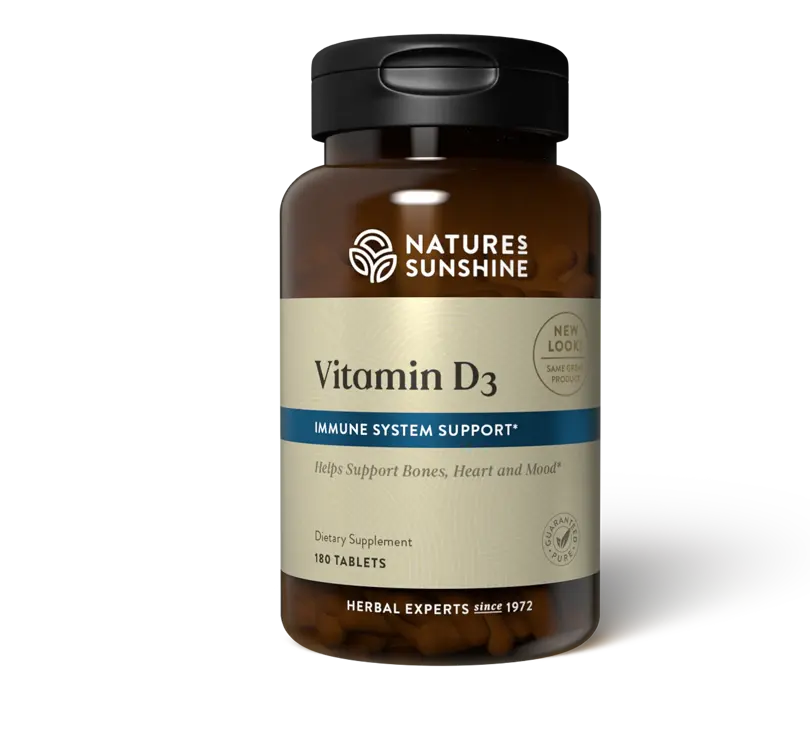
Nature's Sunshine Vitamin D3 provides 100 mcg (4,000 IU) per 2-tablet serving — right at the IOM's Tolerable Upper Intake Level for adults. This product is non-GMO and comes in a 180-tablet bottle. The directions are straightforward: take 2 tablets daily with a meal. Taking Vitamin D3 with a meal that contains fat may enhance absorption, since it is a fat-soluble nutrient absorbed in the small intestine through both passive diffusion and carrier-protein mechanisms.
If you're considering a dose higher than 4,000 IU daily — such as 5,000 IU — it would be wise to discuss this with a healthcare professional, since individual factors like baseline 25(OH)D levels, body weight, skin pigmentation, medications, and health conditions all affect how much you need. Our naturopath offers free consultations and can help you think through what makes sense for your situation.
Important Safety Considerations
Vitamin D is among the least toxic fat-soluble vitamins, and toxicity is exceedingly rare — especially when serum Calcium is monitored. The prevention and correction of vitamin D deficiency with 800–1,000 IU daily is considered safe. Because of their potential for harm, larger doses given long-term should not be used without clinical supervision.
Notably, research shows that very high intermittent bolus doses can be counterproductive. A yearly dose of 500,000 IU was associated with a 15% higher risk of falling in women at high risk of fracture. The mechanistic explanation proposed involves supraphysiological spikes in 25(OH)D causing compensatory downregulation of the VDR. Steady daily dosing appears to be a safer approach than large infrequent boluses.
Drug Interactions to Be Aware Of
- Corticosteroids impair how the body handles vitamin D, leading to lower Calcium absorption and bone loss over time.
- Orlistat (a weight-loss medication) and cholestyramine (a cholesterol-lowering drug) can reduce the absorption of vitamin D and other fat-soluble vitamins.
- Phenobarbital and phenytoin (anti-seizure medications) increase the breakdown of vitamin D and reduce Calcium absorption.
- Thiazide diuretics decrease urinary Calcium elimination, so monitoring of serum Calcium concentration is recommended.
- Digitalis and other cardiac glycosides — the administration of Vitamin D3 may increase the risk of digitalis toxicity. Strict medical supervision is needed.
- Statins may theoretically interact with vitamin D synthesis through competition for CYP3A4 activity.
If you take any of these medications, speak with a qualified healthcare provider before starting or adjusting Vitamin D3 supplementation.
Written by Greg Howlett
Frequently asked questions
Is 5,000 IU of Vitamin D3 daily safe for adults?
The Institute of Medicine's Tolerable Upper Intake Level (UL) for adults is 4,000 IU/day (100 mcg). This means 5,000 IU exceeds the established UL by 1,000 IU. The UL is not a hard threshold for immediate harm — it is the level above which the risk of adverse effects begins to increase. Clinical maintenance dosing studies have used doses well above this without evidence of toxicity when monitored, but larger doses given long-term should not be used without clinical supervision. Individual factors such as baseline vitamin D status, health conditions, and medications all matter.
What is the difference between Vitamin D3 and vitamin D2?
Vitamin D3 (cholecalciferol) is synthesized in human skin and obtained from animal-origin dietary sources, while vitamin D2 (ergocalciferol) is derived from plants. Research suggests Vitamin D3 could be more than three times as effective as D2 in raising serum 25(OH)D concentrations and maintaining those levels for a longer time, and its metabolites have superior affinity for vitamin D-binding proteins in plasma. Both forms undergo the same metabolic activation steps and function as prohormones.
How much Vitamin D3 does this Nature's Sunshine product provide per serving?
Each 2-tablet serving of Nature's Sunshine Vitamin D3 provides 100 mcg of Vitamin D3 (cholecalciferol), which is equivalent to 4,000 IU. The biological activity of 1 mcg of vitamin D equals 40 IU. The directions are to take 2 tablets daily with a meal.
What are the signs of vitamin D toxicity?
Very high levels of vitamin D in the blood (greater than 375 nmol/L or 150 ng/mL) can cause nausea, vomiting, muscle weakness, confusion, pain, loss of appetite, dehydration, excessive urination and thirst, and kidney stones. Extremely high levels can cause kidney failure, irregular heartbeat, and even death. Toxicity is almost always caused by excessive supplement intake — you cannot get too much vitamin D from sunshine because your skin limits the amount it makes.
Who is most at risk for vitamin D deficiency?
High-risk populations include individuals with limited sun exposure, older adults, people with darker skin tones (whose cutaneous vitamin D synthesis is lower), and people with malabsorption disorders. Cloud cover, smog, and aging also reduce the amount of vitamin D your skin makes. According to the National Health and Nutrition Examination Survey, most people in the United States consume less than the recommended amounts of vitamin D.
Should I take Vitamin D3 with food?
Yes. The Nature's Sunshine product directions specify taking 2 tablets daily with a meal. Vitamin D3 is a fat-soluble nutrient, and the concurrent presence of fat in the gut enhances its absorption. It is well absorbed in the small intestine through both passive diffusion and intestinal membrane carrier proteins. Some vitamin D is absorbed even without dietary fat, but a meal that includes fat may optimize absorption.
Talk to Dr. Shannyn Fowl
Not sure if this is right for you? Book a free, no-pressure consultation for personalized guidance on your health goals.
Book your free consult →About Caring Sunshine
A family-run reseller of premium supplements — free shipping, a 90-day guarantee, and real people who know the products.
Learn more about us →