
Vitamin C Deficiency Symptoms & How to Support Your Body
Learn about Vitamin C deficiency symptoms, from fatigue to poor wound healing, and discover how time-release Vitamin C with bioflavonoids supports your health.
What Are Vitamin C Deficiency Symptoms and Why Do They Matter?
Vitamin C (ascorbic acid) is a water-soluble nutrient the body cannot manufacture on its own due to mutations in the L-gulonolactone oxidase (GLO) gene. That means every milligram must come from food or supplementation — and when intake runs low, the consequences show up across multiple body systems.
Clinically, hypovitaminosis C is defined by a plasma ascorbic acid level below 23 µmol/L (approximately 0.4 mg/dL). When levels fall below roughly 10 mg/day for many weeks, overt deficiency — historically known as scurvy — can develop. Vitamin C deficiency symptoms include fatigue, inflammation of the gums, small red or purple spots on the skin, joint pain, poor wound healing, and corkscrew hairs. Additional signs include depression, swollen and bleeding gums, loosening or loss of teeth, and anemia. If left untreated, scurvy is fatal.
Even before full-blown scurvy develops, inadequate Vitamin C may compromise immune function, slow collagen production, and limit the body's ability to fight free radicals. A plasma level of 50 µmol/L (~0.9 mg/dL) is now widely considered the threshold for adequacy — a level sufficient to meet metabolic demands and support ongoing health.
The Critical Roles Vitamin C Plays in Your Body
Understanding why Vitamin C deficiency symptoms are so wide-ranging starts with appreciating just how many jobs this nutrient performs. Vitamin C is a potent antioxidant and a cofactor for a family of biosynthetic and gene regulatory enzymes. Its biological activity derives from its chemical structure as a lactone with two enolic hydroxyl groups that allow it to act as a powerful reducing agent.
Collagen and Connective Tissue
Vitamin C plays an essential role in the proper folding and deposition of collagen proteins — the most abundant proteins in the human body. Without adequate Vitamin C, prolyl and lysyl hydroxylase enzymes cannot properly hydroxylate collagen precursors, leading to structurally defective collagen. This failure of collagen synthesis is the biochemical basis behind many Vitamin C deficiency symptoms, including poor wound healing, bleeding gums, and skin fragility.
Immune Defense
Research shows that Vitamin C contributes to immune defense by supporting various cellular functions of both the innate and adaptive immune system. It helps maintain epithelial barrier function against pathogens, supports the oxidant scavenging activity of the skin, enhances phagocytosis, normalizes cytokine production, and decreases histamine levels. More than half a century of research has demonstrated Vitamin C to be a crucial player in immune cell function.
Antioxidant Protection
Vitamin C functions physiologically as a water-soluble antioxidant, quenching a variety of reactive oxygen species and reactive nitrogen species in aqueous environments. It also regenerates other antioxidants such as vitamin E, potentially helping support the body against oxidative stress-related concerns.
Iron Absorption
Vitamin C improves the absorption of iron from plant-based foods by reducing ferric iron (Fe³⁺) to ferrous iron (Fe²⁺) in the gastrointestinal lumen — a form that is more readily absorbed by intestinal mucosal cells. This is clinically relevant for people who rely heavily on non-heme iron sources.
Who Should Pay Attention to Vitamin C Deficiency Symptoms?
While overt scurvy is rare today thanks to improved food supplies and supplementation, certain groups may be more susceptible to inadequate Vitamin C status:
- Smokers: The RDA recommends that smokers increase their Vitamin C consumption by 35 mg per day regardless of sex, reflecting the elevated oxidative stress tobacco creates.
- People with limited fruit and vegetable intake: Since the best sources of Vitamin C are fruits and vegetables — especially citrus fruits, red and green peppers, kiwifruit, broccoli, and strawberries — those whose diets rely heavily on meat and starch may fall short.
- Active individuals and those under physical stress: Research suggests that Vitamin C may be useful for people exposed to brief periods of severe physical exercise, and populations under high physical stress show greater benefit from regular supplementation.
- Anyone concerned about seasonal immune challenges: Vitamin C supports epithelial barrier function and immune cell activity. A Cochrane review found that regular supplementation modestly reduces the duration of colds — by about 8% in adults and 14% in children — though it does not appear to prevent colds in the general population.
If you're unsure whether your intake is adequate, our naturopath offers free consultations and can help you think through whether a Vitamin C supplement makes sense for your individual situation.
How Nature's Sunshine Vitamin C Time Release Works
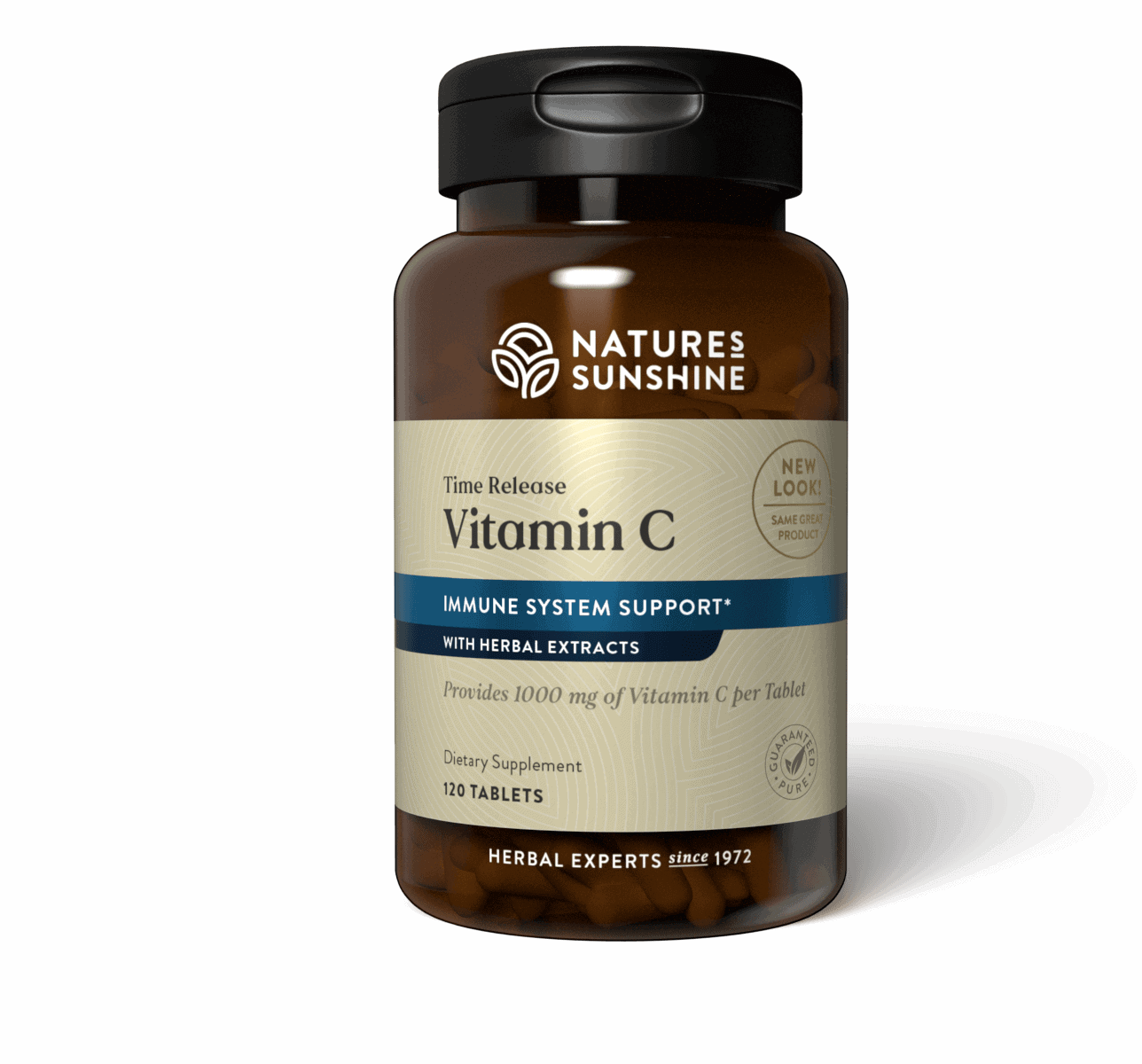
Nature's Sunshine Vitamin C Time Release is designed to deliver the benefits of Vitamin C throughout the day rather than all at once. Each tablet includes a special coating that slows the absorption of the nutrients until they reach the intestines. This matters because at typical dietary intakes (30 to 180 mg/day), about 70 to 90 percent of ascorbic acid is absorbed, but absorption falls to approximately 50 percent or less with increasing doses above 1 g/day. A time-release approach helps the body make the most of each tablet.
This formula is completely natural with no sugar, starch, artificial colorings, or flavorings, and is both vegan and non-GMO. The Vitamin C (ascorbic acid) is blended with a base of Rose hips extract, acerola fruit extract, Rutin, Lemon bioflavonoid extract, and Hesperidin bioflavonoid extract — a bioflavonoid-rich complement that mirrors how Vitamin C appears alongside these compounds in nature.
Directions
Take one tablet daily with a meal. Each bottle contains 120 tablets.
Key ingredients
- ✓ Envío gratis en pedidos superiores a $75
- ✓ Devoluciones fáciles en 90 días
- ✓ Envíos en pocas horas
Escrito por Greg Howlett
Preguntas frecuentes
What are the most common Vitamin C deficiency symptoms?
Vitamin C deficiency symptoms include fatigue, inflammation of the gums, small red or purple spots on the skin, joint pain, poor wound healing, and corkscrew hairs. More advanced deficiency can cause depression, swollen and bleeding gums, loosening or loss of teeth, and anemia. These symptoms occur when Vitamin C intake falls below approximately 10 mg/day for many weeks, and the condition is fatal if left untreated.
How much Vitamin C do I need each day to avoid deficiency?
The Recommended Dietary Allowance (RDA) is 90 mg/day for adult men and 75 mg/day for adult women. Pregnant women are recommended 85 mg/day, and lactating women 120 mg/day. Smokers should add 35 mg per day beyond the standard RDA. The Tolerable Upper Intake Level is set at 2,000 mg per day for adults to prevent gastrointestinal discomfort.
Does Vitamin C actually help with colds?
According to a Cochrane review of 30 trials involving over 11,000 participants, regular Vitamin C supplementation does not prevent colds in the general population. However, research shows it modestly reduces cold duration — by about 8% in adults and 14% in children. The benefit appears stronger for people under severe physical stress, such as marathon runners. Taking Vitamin C after a cold has already started does not appear to be helpful.
Why does this formula include bioflavonoids like Rutin and Hesperidin?
The Vitamin C in this formula is blended with Rose hips extract, acerola fruit extract, Rutin, Lemon bioflavonoid extract, and Hesperidin — compounds that naturally accompany Vitamin C in whole foods. Each contributes its own documented antioxidant and immune-supportive properties. For example, research shows Rutin modulates immunity through NF-κB-dependent pathways, while Hesperidin has been shown in human studies to support the oxidative-inflammatory state. Together they create a more complete bioflavonoid profile.
What makes a time-release Vitamin C tablet different from a regular one?
At doses above 1 g/day, absorption of Vitamin C falls to about 50% or less. Nature's Sunshine Vitamin C Time Release includes a special coating that slows the absorption of nutrients until they reach the intestines, helping deliver Vitamin C's benefits throughout the day rather than in a single burst. This approach works with the body's saturable, dose-dependent absorption process.
Can I take too much Vitamin C?
Amounts greater than 2,000 mg per day are not recommended. Taking too much Vitamin C can cause gastrointestinal side effects including stomach upset, stomach cramps, bloating, and diarrhea. At high doses, a minor metabolite of Vitamin C is oxalate, and elevated urinary oxalate excretion has been reported after intakes of 2 g/day, raising some concern about kidney stone risk — particularly in people who already have multiple risk factors. People with G6PD deficiency, hemochromatosis, or kidney disease should speak with a healthcare provider before supplementing.
Talk to Dr. Shannyn Fowl
Not sure if this is right for you? Book a free, no-pressure consultation for personalized guidance on your health goals.
Book your free consult →About Caring Sunshine
A family-run reseller of premium supplements — free shipping, a 90-day guarantee, and real people who know the products.
Learn more about us →