
Best Vitamin C Supplement | Time-Release Formula
Discover the best Vitamin C supplement with time-release delivery, Rose hips, acerola, Rutin & bioflavonoids. Learn about ingredients, benefits & how to take it.
Why Vitamin C Deserves a Place in Your Daily Routine
If you're searching for the best Vitamin C supplement, you're looking for something that does more than deliver a single burst of nutrients. Vitamin C (ascorbic acid) is a water-soluble nutrient the human body cannot produce on its own — the gene responsible for its synthesis carries a mutation that makes us entirely dependent on dietary and supplemental sources.
As a potent antioxidant and enzymatic cofactor, Vitamin C is involved in an impressive range of biological functions: it supports the immune system, fights free radicals, assists in the production of collagen, nourishes tissues, and enhances the absorption of iron from plant-based foods. It also contributes to carnitine synthesis, catecholamine metabolism, and adrenal hormone production.
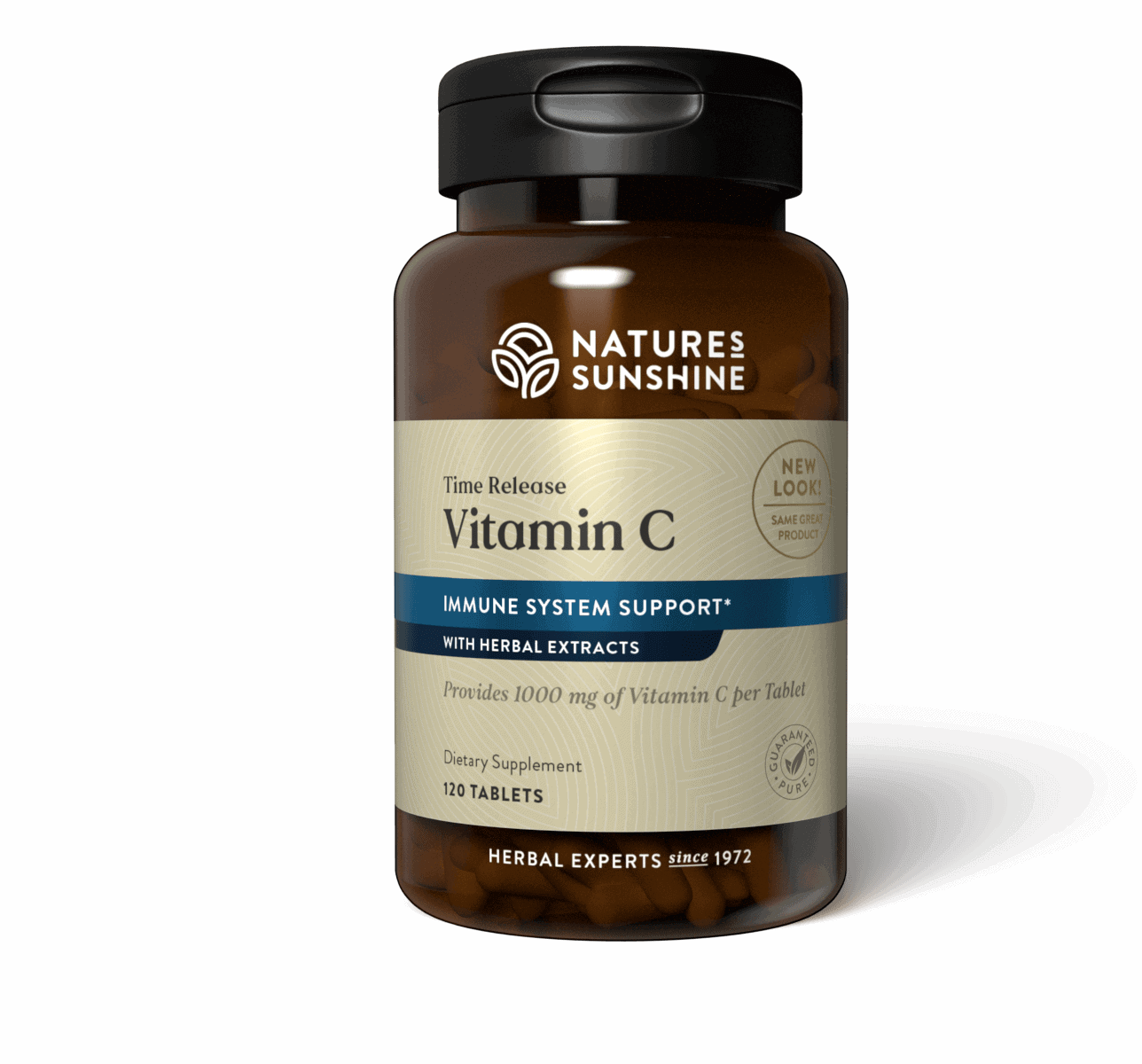
Nature's Sunshine Vitamin C Time Release (1000 mg) is designed to deliver these benefits steadily throughout the day. Each tablet features a special coating that slows absorption until the nutrients reach the intestines, addressing the well-documented fact that absorption falls to about 50% or less with single doses above 1 g. By releasing Vitamin C gradually, a time-release format helps the body use more of what you take.
This completely natural product contains no sugar, starch, artificial colorings, or flavorings, and it is both vegan and non-GMO. The Vitamin C is blended with a synergistic base of Rose hips extract, acerola extract, Rutin, Lemon bioflavonoids, and Hesperidin complex — whole-food and plant-derived cofactors that complement ascorbic acid's activity.
Time-Release Delivery and the Bioflavonoid Advantage
One challenge with high-dose Vitamin C is that the body can only absorb so much at once. Research shows that 70–90% of usual dietary intakes (30–180 mg/day) are absorbed, but absorption drops significantly at doses above 1 g. A time-release tablet addresses this directly — the special coating slows nutrient release so Vitamin C is delivered to the intestines gradually rather than all at once.
Beyond delivery, what makes this formula stand out as the best Vitamin C supplement for many people is its bioflavonoid base. Bioflavonoids — including Rutin, Hesperidin, and Lemon bioflavonoids — are polyphenolic compounds naturally found alongside Vitamin C in fruits. Research suggests these compounds offer their own antioxidant and anti-inflammatory properties that work in concert with ascorbic acid.
Rose hips and acerola are among the richest natural sources of Vitamin C in the plant kingdom, and both carry their own constellation of carotenoids, polyphenols, and flavonoids. Together, these ingredients create a whole-food-inspired formula rather than a simple ascorbic acid tablet.
If you have questions about whether this formula is right for your individual needs, our naturopath is available for a free consultation — no strings attached.
Key ingredients
- ✓ Envío gratis en pedidos superiores a $75
- ✓ Devoluciones fáciles en 90 días
- ✓ Envíos en pocas horas
Who Should Consider a Time-Release Vitamin C
This formula may be particularly well-suited for people looking for daily immune support, antioxidant defense, collagen production support, and tissue nourishment — especially those who want their Vitamin C to work steadily rather than spike and decline.
Because Vitamin C is rapidly consumed during infections and the body's plasma concentrations decline during viral illness, people heading into cold and flu season or recovering from illness may find ongoing supplementation especially relevant. Research suggests regular supplementation modestly reduces cold duration and severity, with more pronounced benefits in populations under heavy physical or cold-weather stress.
Individuals who eat limited fresh fruits and vegetables, smokers (who have higher Vitamin C requirements — the RDA recommends an additional 35 mg/day for smokers regardless of sex), and people seeking to support iron absorption from plant-based diets may also benefit.
This product is vegan and non-GMO, making it suitable for plant-based lifestyles. As always, if you're taking medications — particularly chemotherapy agents, statins, estrogen-containing medications, or anticoagulants — or if you have a condition like G6PD deficiency, hemochromatosis, or kidney disease, we recommend speaking with a healthcare professional. Our naturopath is happy to discuss how this supplement fits with your personal health picture during a free consultation.
How to Take Vitamin C Time Release
Directions: Take one tablet daily with a meal.
Each bottle contains 120 tablets — a four-month supply at the recommended serving. Taking your tablet with food aligns with the body's natural digestive processes and may support optimal absorption.
The Tolerable Upper Intake Level (UL) for Vitamin C in adults, set by the Institute of Medicine, is 2,000 mg per day. At 1,000 mg per tablet, this product provides a dose well within established safety margins. Taking too much Vitamin C can occasionally cause gastrointestinal discomfort, including stomach upset and loose stools — the time-release format is designed to reduce this concern by slowing delivery to the intestines.
Escrito por Greg Howlett
Preguntas frecuentes
What makes a time-release Vitamin C different from regular Vitamin C?
A time-release Vitamin C tablet features a special coating that slows the absorption of nutrients until they reach the intestines, delivering Vitamin C gradually throughout the day rather than in a single burst. This matters because research shows absorption falls to about 50% or less with single doses above 1 g/day. By releasing Vitamin C over time, the body has a better opportunity to absorb and use more of the nutrient.
Why does this formula include Rose hips, acerola, Rutin, and bioflavonoids?
The Vitamin C in this formula is blended with a base of Rose hips extract, acerola extract, Rutin, Lemon bioflavonoids, and Hesperidin complex. These plant-derived compounds are natural sources of polyphenols, flavonoids, and additional antioxidants that research suggests offer their own health benefits — from immune modulation to antioxidant defense. They naturally accompany Vitamin C in whole fruits and may complement its activity in the body.
Can Vitamin C help prevent the common cold?
A Cochrane review of 29 trials involving over 11,000 participants found that regular Vitamin C supplementation does not prevent colds in the general population. However, it modestly reduces cold duration (by about 8% in adults and 14% in children) and may reduce severity. Benefits appear more pronounced in people exposed to severe physical stress, such as marathon runners or military personnel. Taking Vitamin C after a cold has already started does not appear to be helpful.
Is 1,000 mg of Vitamin C per day safe?
The Institute of Medicine has set the Tolerable Upper Intake Level (UL) for adults at 2,000 mg per day of Vitamin C. At 1,000 mg per tablet, this product is well within that limit. The most commonly reported side effect of high-dose Vitamin C is gastrointestinal discomfort (stomach upset, diarrhea), which the time-release format is designed to minimize. People with kidney disease, G6PD deficiency, or hemochromatosis should consult a healthcare professional before taking high-dose Vitamin C.
Is this supplement suitable for vegans?
Yes. Nature's Sunshine Vitamin C Time Release is a completely natural product that is both vegan and non-GMO. It contains no sugar, starch, artificial colorings, or flavorings.
How does Vitamin C support collagen production?
Vitamin C is an essential cofactor for prolyl and lysyl hydroxylase enzymes, which are required for the proper hydroxylation and folding of collagen precursors. Collagen is the most abundant protein in the human body and is critical for skin integrity, wound healing, bone strength, and blood vessel structure. Without adequate Vitamin C, these enzymes cannot function properly, which is the biochemical basis of scurvy's connective tissue breakdown.
Talk to Dr. Shannyn Fowl
Not sure if this is right for you? Book a free, no-pressure consultation for personalized guidance on your health goals.
Book your free consult →About Caring Sunshine
A family-run reseller of premium supplements — free shipping, a 90-day guarantee, and real people who know the products.
Learn more about us →