
Cúrcuma y curcumina: evidencia antiinflamatoria
Descubre la evidencia clínica sobre la cúrcuma y la curcumina: estudios, metaanálisis y beneficios para articulaciones y el intestino.
La evidencia antiinflamatoria de la cúrcuma y la curcumina: lo que debes saber
La cúrcuma se ha usado durante casi 6,000 años en la medicina ayurvédica y la medicina tradicional asiática, principalmente por sus propiedades antiinflamatorias y analgésicas. Hoy, un cuerpo considerable de investigación moderna ha puesto a prueba esos usos tradicionales: la evidencia antiinflamatoria de la cúrcuma y la curcumina es prometedora y matizada a la vez.
La curcumina, el principal polifenol bioactivo de la cúrcuma, se ha investigado extensamente por su capacidad de modular múltiples vías de señalización implicadas en las respuestas inflamatorias. Los estudios muestran que actúa inhibiendo la vía de señalización de NF-κB y reduciendo la producción de citocinas inflamatorias como el TNF-α y la IL-1β. También suprime las enzimas COX-2 y LOX, responsables de producir prostaglandinas y leucotrienos: mediadores inflamatorios clave.
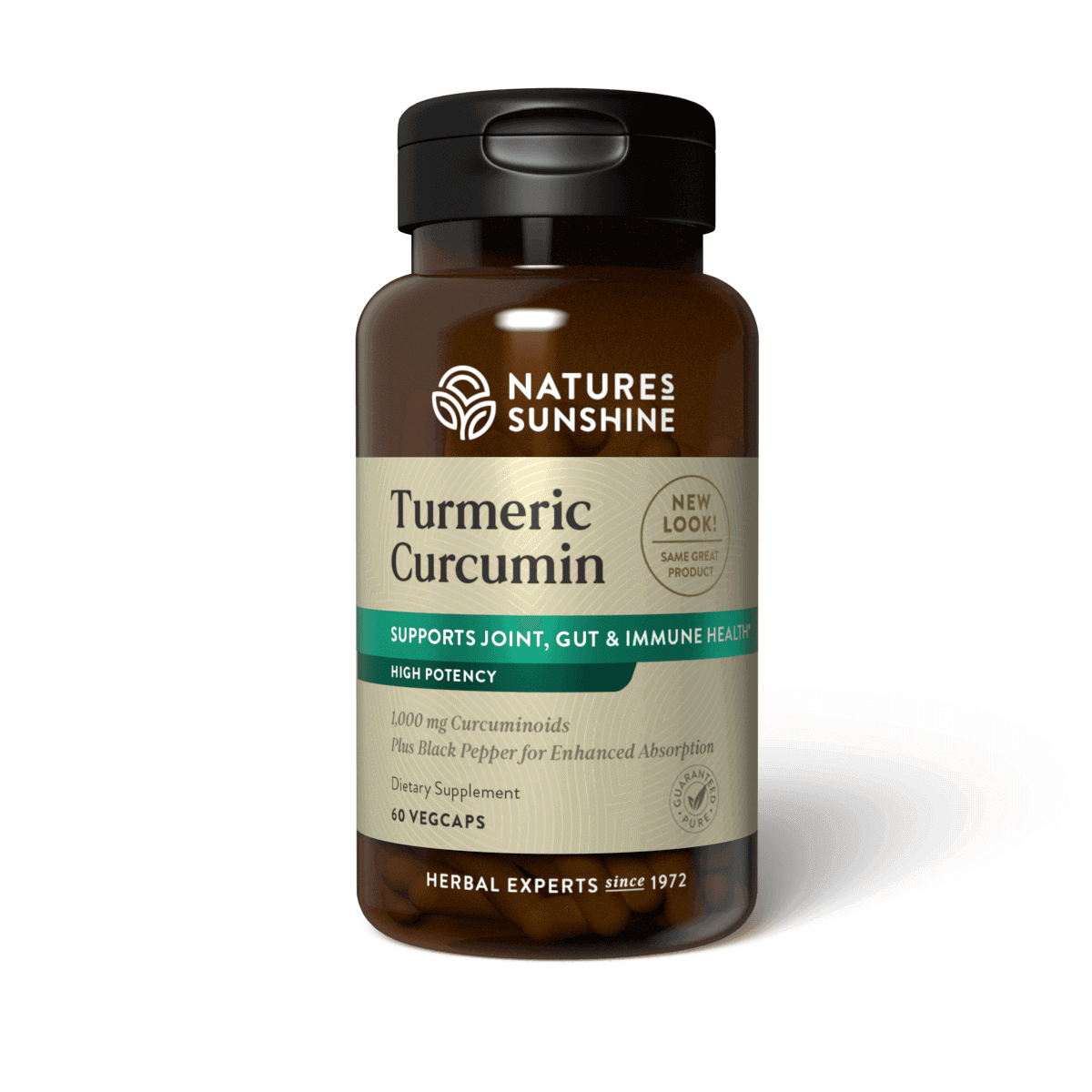
Turmeric Curcumin de Nature's Sunshine aporta 1,100 mg de extracto de cúrcuma y 1,000 mg de curcuminoides por porción, potenciado con extracto de pimienta negra para favorecer la absorción. Una porción equivale a 32,000 mg de cúrcuma de raíz entera, y la fórmula ha sido estudiada clínicamente por su absorción y eficacia superiores.
Si tienes curiosidad por saber cómo esta fórmula podría ajustarse a tus objetivos de bienestar, nuestro naturópata te ofrece una consulta gratuita para ayudarte a entender la investigación y encontrar el enfoque adecuado.
Los mecanismos detrás de la actividad antiinflamatoria de la curcumina
La evidencia antiinflamatoria de la cúrcuma y la curcumina se centra en la capacidad de la curcumina de actuar sobre múltiples vías inflamatorias al mismo tiempo. La investigación muestra que la curcumina ejerce sus efectos principales sobre todo al inhibir la activación de la vía de señalización del factor nuclear κB (NF-κB), regular la cascada de fosforilación MAPK/ERK y modular la vía JAK/STAT.
Además de estos mecanismos principales, la curcumina también activa la vía de señalización Nrf2-Keap1/ARE, que aumenta la expresión de las propias enzimas antioxidantes de defensa del cuerpo, incluidas la superóxido dismutasa (SOD), la catalasa y el glutatión. Múltiples ensayos controlados aleatorizados (ECA) y metaanálisis en humanos han mostrado que la curcumina aumenta de forma medible la capacidad antioxidante total, a la vez que reduce el malondialdehído (MDA), un marcador de la peroxidación lipídica.
Una advertencia importante que se repite en toda la literatura científica: la curcumina tiene una biodisponibilidad oral inherentemente baja debido a su baja solubilidad en agua, su escasa permeabilidad intestinal y su metabolismo rápido. Por eso la inclusión del extracto de pimienta negra —que contiene el alcaloide piperina— es significativa. En un estudio de referencia en humanos, la administración conjunta de curcumina con piperina aumentó la biodisponibilidad de la curcumina en un 2,000%. Esta fórmula incorpora extracto de pimienta negra específicamente para abordar este reto.
Cabe señalar también que, si bien la curcumina afecta varias funciones celulares en entornos de laboratorio, estos efectos suelen producirse a concentraciones que no se alcanzan fácilmente en el cuerpo mediante la dosificación oral. Esta brecha entre los hallazgos preclínicos y los resultados clínicos es un tema recurrente en la investigación sobre la cúrcuma y es importante tenerla en cuenta al evaluar la evidencia.
Qué dicen los ensayos clínicos y los metaanálisis
Salud articular y osteoartritis
La osteoartritis —en particular la osteoartritis de rodilla— es la indicación más investigada para la cúrcuma y la curcumina en ensayos clínicos en humanos. Una revisión sistemática y metaanálisis en red de 2025 con 17 estudios observó que todas las preparaciones de cúrcuma redujeron de forma significativa el dolor según la escala WOMAC en comparación con placebo. La preparación con biodisponibilidad mejorada mostró una reducción del 30% en el dolor WOMAC, alcanzando el umbral de diferencia mínima clínicamente importante.
Una revisión sistemática y metaanálisis de 2022 examinó 29 ECA con 2,396 participantes en cinco tipos de artritis, entre ellos la osteoartritis, la artritis reumatoide y la espondilitis anquilosante. Otro metaanálisis verificó que el extracto de curcumina/cúrcuma tenía una eficacia terapéutica similar a la de los antiinflamatorios no esteroideos (AINE), con base en los hallazgos de 16 ECA y 1,810 adultos. Sin embargo, la calidad de la evidencia se califica de forma constante como baja a muy baja debido al tamaño reducido de las muestras, el alto riesgo de sesgo y la heterogeneidad metodológica.
Inflamación crónica y marcadores metabólicos
Una revisión sistemática y metaanálisis de 2025 observó que la suplementación con curcumina redujo de forma significativa la proteína C reactiva (PCR), el TNF-α y la IL-6 —biomarcadores inflamatorios clave— en personas con síndrome metabólico y diabetes tipo 2. También mejoró la glucemia en ayunas, la HbA1c, los triglicéridos, el colesterol LDL y el colesterol HDL. Una revisión de 2024 publicada en Nutrients identificó 54 metaanálisis de ECA de curcumina y observó reducciones de la PCR en siete de diez metaanálisis y reducciones de la IL-6 en cinco de ocho.
Enfermedad inflamatoria intestinal
Un metaanálisis de 2025 con 13 ECA controlados con placebo mostró la eficacia significativa de la curcumina para lograr la remisión clínica y la respuesta en pacientes con colitis ulcerosa como terapia adyuvante. La evidencia para la enfermedad de Crohn es más limitada, y la heterogeneidad en las formulaciones y dosis limita las conclusiones firmes.
Función cognitiva y estado de ánimo
La evidencia preclínica sobre los efectos neuroprotectores de la curcumina es extensa, y abarca mecanismos antiamiloide, antitau, de restauración del BDNF y de supresión de la neuroinflamación. En un estudio clínico, 1,500 mg/día de BCM-95 durante 12 meses estabilizó la función cognitiva en adultos mayores en comparación con placebo. La investigación también sugiere que la curcumina podría mejorar modestamente las puntuaciones de síntomas depresivos, aunque los resultados se consideran preliminares, con tamaños de efecto variables.
Una visión equilibrada
Si bien la evidencia antiinflamatoria de la cúrcuma y la curcumina es prometedora en múltiples áreas de la salud, interpretarla exige tener en cuenta que las calificaciones de certeza GRADE son predominantemente de bajas a muy bajas, que los estudios primarios suelen tener limitaciones metodológicas frecuentes y que existe heterogeneidad en las formulaciones estudiadas bajo el término general "curcumina". El desafío central del campo —que las concentraciones que han mostrado actividad biológica en el laboratorio podrían no alcanzarse plenamente en la circulación humana— sigue sin resolverse del todo, incluso con fórmulas de liberación mejorada.
Ingredientes clave
- ✓ Envío gratis en pedidos superiores a $75
- ✓ Devoluciones fáciles en 90 días
- ✓ Envíos en pocas horas
Quiénes pueden beneficiarse de Turmeric Curcumin para apoyar una respuesta inflamatoria saludable
Según la evidencia antiinflamatoria de la cúrcuma y la curcumina, esta fórmula puede ser una buena opción para varios grupos de personas:
- Adultos con rigidez articular o molestias ocasionales: múltiples revisiones sistemáticas respaldan el uso de la curcumina para el dolor y la función en la osteoartritis de rodilla, con cierta evidencia de una eficacia comparable a la de los AINE.
- Quienes buscan apoyar una respuesta inflamatoria saludable: los metaanálisis muestran que la curcumina podría ayudar a reducir biomarcadores inflamatorios clave como la PCR, la IL-6 y el TNF-α, en particular en personas con problemas metabólicos.
- Personas interesadas en el apoyo antioxidante: los ensayos clínicos muestran que la curcumina podría aumentar la capacidad antioxidante total y las enzimas antioxidantes endógenas, a la vez que reduce los marcadores de estrés oxidativo.
- Cualquier persona que busque apoyo natural para las articulaciones, la piel, el cerebro y el intestino: la fórmula está diseñada para favorecer una respuesta inflamatoria saludable que, a su vez, apoya estos sistemas corporales interconectados.
Este producto no contiene OGM y viene en cápsulas vegetales, lo que lo hace apto para muchas preferencias alimentarias. Si tienes dudas sobre si Turmeric Curcumin es adecuado para tu situación —en especial si tomas medicamentos—, nuestro naturópata te ofrece consultas gratuitas y puede ayudarte a analizar la investigación en el contexto de tu propia salud.
Cómo tomar Turmeric Curcumin
Toma 2 cápsulas vegetales al día.
Cada frasco contiene 60 cápsulas (un suministro para 30 días según la porción recomendada de 2 cápsulas vegetales). La fórmula está potenciada con extracto de pimienta negra para favorecer la absorción de la curcumina: la investigación muestra que la piperina de la pimienta negra podría aumentar la biodisponibilidad de la curcumina hasta en un 2,000%.
Notas de seguridad importantes según la investigación: Se ha descrito que la curcumina es segura hasta 6 gramos al día durante 4 a 7 semanas en ensayos clínicos. Sin embargo, las alteraciones gastrointestinales, como náuseas, diarrea y malestar estomacal, son los efectos secundarios descritos con mayor frecuencia, en particular con dosis más altas. También existe un riesgo poco frecuente de daño hepático asociado con los suplementos de cúrcuma, que podría ser mayor con las fórmulas de absorción mejorada. Las personas con problemas hepáticos existentes deben tener precaución. La piperina puede inhibir ciertas enzimas que metabolizan medicamentos (CYP3A4, CYP2C9, glucoproteína P), lo que podría afectar la forma en que tu cuerpo procesa ciertos medicamentos, incluidos la warfarina, la carbamazepina y otros. Si tomas medicamentos, consulta con un profesional de la salud antes de comenzar a tomar este suplemento.
Escrito por Greg Howlett
Preguntas frecuentes
¿En qué se basa la evidencia antiinflamatoria de la cúrcuma y la curcumina?
La evidencia proviene de múltiples revisiones sistemáticas, metaanálisis y ECA en humanos. Se ha demostrado que la curcumina inhibe la vía de señalización de NF-κB y reduce citocinas inflamatorias como el TNF-α, la IL-1β y la IL-6. Un metaanálisis de 2025 con 21 estudios en osteoartritis de rodilla observó niveles significativamente más bajos de PCR y TNF-α en los grupos que tomaron curcumina frente al placebo. Una revisión de 2024 publicada en Nutrients identificó 54 metaanálisis de ECA de curcumina que abarcan la inflamación, el estado antioxidante, el control de la glucosa y más. Sin embargo, la calidad de la evidencia generalmente se califica de baja a muy baja, y aún se necesitan ensayos más grandes y de mayor duración.
¿Cómo mejora el extracto de pimienta negra la absorción de la curcumina?
La piperina, el alcaloide activo de la pimienta negra, inhibe enzimas (CYP3A4, UGT) y transportadores (glucoproteína P) que normalmente descomponen y eliminan la curcumina con rapidez. En un estudio farmacocinético de referencia en humanos, la administración conjunta de piperina con curcumina aumentó la biodisponibilidad de la curcumina en un 2,000%. Esto es relevante porque la baja biodisponibilidad oral de la curcumina se cita ampliamente como la principal barrera para traducir sus prometedores hallazgos de laboratorio en beneficios clínicos.
¿Pueden la cúrcuma y la curcumina ayudar con el dolor articular y la osteoartritis?
La investigación sugiere que sí podrían. Un metaanálisis en red de 2025 con 17 estudios observó que todas las preparaciones de cúrcuma redujeron de forma significativa el dolor WOMAC en la osteoartritis de rodilla en comparación con placebo. Un metaanálisis independiente verificó que la curcumina tenía una eficacia terapéutica similar a la de los AINE en 16 ECA con 1,810 adultos. Una revisión de 2022 con 29 ECA que abarcó cinco tipos de artritis —incluidas la osteoartritis, la artritis reumatoide y la espondilitis anquilosante— también confirmó estos beneficios. Dicho esto, la certeza de la evidencia sigue siendo baja, lo que refleja el tamaño reducido de las muestras y la variabilidad metodológica entre los estudios.
¿Es seguro tomar Turmeric Curcumin todos los días?
La curcumina está aprobada por la FDA como GRAS (reconocida en general como segura) en calidad de ingrediente alimentario. Los ensayos clínicos indican que es segura hasta 6 gramos al día durante 4 a 7 semanas. Los efectos adversos leves —principalmente alteraciones gastrointestinales— han sido poco frecuentes y suelen resolverse al reducir la dosis. Sin embargo, existe un riesgo poco frecuente de daño hepático, que podría ser mayor con las fórmulas de biodisponibilidad mejorada. Las personas con afecciones hepáticas existentes o que toman medicamentos (en especial anticoagulantes o fármacos metabolizados por el CYP3A4) deben consultar a un profesional de la salud antes de usarlo.
¿Cuánta curcumina aporta este producto por porción?
Cada porción de dos cápsulas vegetales aporta 1,100 mg de extracto de cúrcuma y 1,000 mg de curcuminoides, los principales compuestos bioactivos de la cúrcuma. Según Nature's Sunshine, una porción equivale a 32,000 mg de cúrcuma de raíz entera, lo que aporta tanto raíz de cúrcuma como niveles más altos de extracto de cúrcuma rico en antioxidantes, en comparación con muchas fórmulas que priorizan la raíz de cúrcuma sobre el extracto.
¿La curcumina ayuda con la inflamación más allá de la salud articular?
La investigación sugiere que la actividad antiinflamatoria de la curcumina se extiende a varios sistemas del cuerpo. Los metaanálisis han mostrado reducciones significativas en biomarcadores inflamatorios (PCR, IL-6, TNF-α) en personas con síndrome metabólico y diabetes tipo 2. Un metaanálisis de 2025 con 13 ECA observó que la curcumina era eficaz como terapia adyuvante para lograr la remisión clínica en la colitis ulcerosa. La evidencia preliminar también sugiere posibles beneficios para el envejecimiento cognitivo y el estado de ánimo, aunque los datos clínicos en esas áreas siguen en una etapa temprana. La curcumina también se ha estudiado extensamente en modelos preclínicos de cáncer, pero la evidencia clínica en humanos para aplicaciones oncológicas es muy limitada.
Talk to Dr. Shannyn Fowl
Not sure if this is right for you? Book a free, no-pressure consultation for personalized guidance on your health goals.
Book your free consult →About Caring Sunshine
A family-run reseller of premium supplements — free shipping, a 90-day guarantee, and real people who know the products.
Learn more about us →