
¿Cúrcuma y curcumina son lo mismo? Diferencias clave
¿Cúrcuma y curcumina son lo mismo? Descubre la diferencia, cómo actúan los curcuminoides y por qué importa la absorción para articulaciones e intestino.
¿Es la cúrcuma lo mismo que la curcumina? Esto es lo que realmente debes saber
Es una de las preguntas más comunes que escuchamos de nuestros clientes: ¿es la cúrcuma lo mismo que la curcumina? La respuesta corta es no; sin embargo, ambas están estrechamente relacionadas. La cúrcuma es la planta entera (Curcuma longa L.), una hierba rizomatosa de la familia del jengibre que se ha usado durante casi 6,000 años en el Ayurveda, la medicina tradicional china y las tradiciones curativas del sudeste asiático. La curcumina es el principal polifenol bioactivo que se encuentra dentro del rizoma de la cúrcuma: el compuesto más responsable de su vibrante color amarillo y el foco de la mayor parte de la investigación moderna.
Aquí está el dato clave: la raíz cruda de cúrcuma normalmente contiene solo alrededor de entre un 2% y un 5% de curcuminoides en peso, y la curcumina representa aproximadamente entre un 75% y un 80% de esa pequeña fracción de curcuminoides. Por eso, una cucharadita de cúrcuma en polvo aporta solo una cantidad modesta de curcumina. Por esto existen extractos estandarizados de cúrcuma: concentran los curcuminoides a niveles muy superiores a los que obtendrías únicamente con el uso culinario.
La cúrcuma también contiene más de 235 fitoquímicos identificados, entre ellos aceites volátiles como ar-turmerona, α-turmerona y β-turmerona, además de otros curcuminoides como la demetoxicurcumina y la bisdemetoxicurcumina. Así que, aunque la curcumina recibe la mayor parte de la atención de la investigación, la planta entera de cúrcuma ofrece un perfil fitoquímico más amplio. Si deseas ayuda para entender las diferencias según tu situación personal, nuestro naturópata te ofrece una consulta gratuita.
Por qué son importantes los mecanismos de la curcumina: la absorción es el verdadero reto
La investigación sugiere que la curcumina ejerce sus efectos principalmente al inhibir la vía de señalización de NF-κB, suprimir la actividad de las enzimas COX-2 y LOX, y regular las cascadas de JAK/STAT y MAPK. Estas son vías clave involucradas en la respuesta inflamatoria del cuerpo. La curcumina también actúa como antioxidante, neutralizando las especies reactivas de oxígeno (ERO) y activando la vía Keap1-Nrf2/ARE, lo que aumenta la expresión de enzimas protectoras propias del cuerpo como la superóxido dismutasa (SOD) y el glutatión.
Sin embargo —y esto es fundamental—, la curcumina tiene una biodisponibilidad oral notoriamente baja. Tiene baja solubilidad en agua, se degrada rápidamente a pH alcalino, y es metabolizada en gran medida por el hígado y el intestino mediante un proceso llamado glucuronidación. Un estudio en animales observó que la absorción oral fue de solo alrededor de un 1%. En humanos, los niveles plasmáticos de curcumina no conjugada se mantuvieron por debajo de 2 nM en la mayoría de las formulaciones comerciales evaluadas en un estudio cruzado independiente.
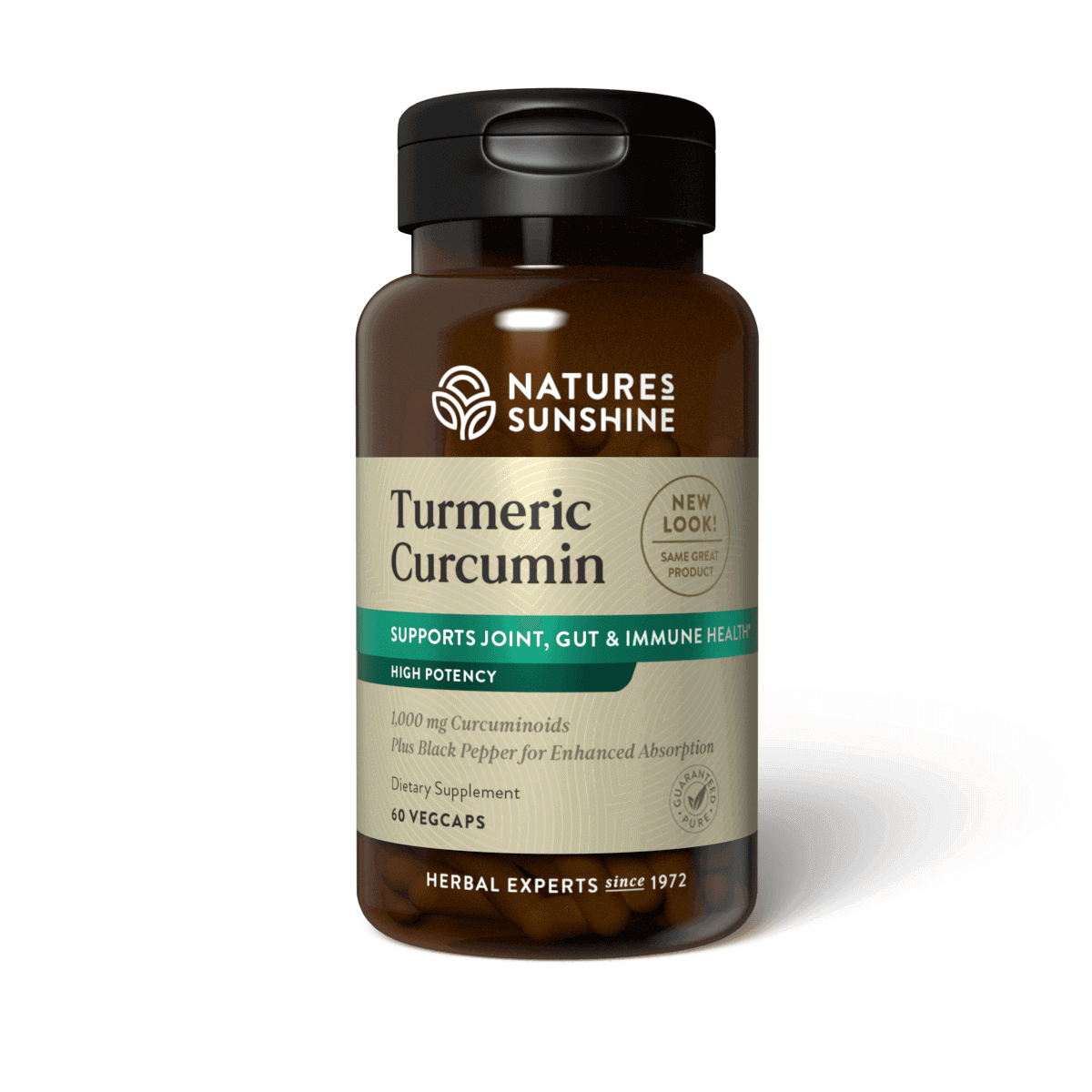
Por esto, la coadministración con piperina (de la pimienta negra) se ha convertido en una de las estrategias de absorción más estudiadas. En humanos, la biodisponibilidad de la curcumina aumentó en un 2,000% cuando se coadministró con piperina. La piperina inhibe las enzimas UGT responsables de la rápida conjugación y eliminación de la curcumina. Turmeric Curcumin de Nature's Sunshine incluye extracto de pimienta negra exactamente por esta razón.
Cabe señalar que, incluso con una absorción mejorada, alcanzar las concentraciones utilizadas en los estudios de laboratorio sigue siendo un reto en la circulación humana. Esta brecha entre la promesa preclínica y los resultados clínicos es un tema recurrente en la investigación sobre la curcumina y es importante tenerla en cuenta al evaluar las declaraciones de salud.
Salud articular, inflamación y más: la evidencia sobre la cúrcuma y la curcumina
Articulaciones y osteoartritis: esta es el área más investigada sobre la cúrcuma y la curcumina en ensayos clínicos en humanos. Una revisión sistemática y metaanálisis en red de 2025 con 17 estudios observó que todas las preparaciones de cúrcuma redujeron de forma significativa las puntuaciones de dolor WOMAC en la osteoartritis de rodilla, y las preparaciones con absorción mejorada mostraron una reducción del 30% en comparación con placebo: alcanzando el umbral de diferencia mínima clínicamente importante. Un metaanálisis separado de 2022 con 29 ensayos controlados aleatorizados (ECA) en cinco tipos de artritis confirmó mejoras consistentes, y otro metaanálisis observó que la eficacia de la curcumina fue similar a la de los antiinflamatorios no esteroideos (AINE), con base en 16 ECA y 1,810 adultos. Sin embargo, la calidad de la evidencia se califica de forma consistente como baja a muy baja debido a los tamaños de muestra pequeños, la variabilidad metodológica y la frecuente participación de la industria.
Inflamación crónica: múltiples metaanálisis de ECA muestran que la curcumina puede reducir biomarcadores inflamatorios clave, entre ellos la proteína C-reactiva (PCR), la IL-6 y el TNF-α. Una revisión sistemática de 2025 en síndrome metabólico observó reducciones significativas en la PCR (diferencia de medias estandarizada, DME = −0.62), el TNF-α (DME = −0.57) y la IL-6 (DME = −0.50). Sin embargo, un metaanálisis de 2019 con 19 ECA no observó una reducción estadísticamente significativa en estos mismos marcadores, lo que refleja un debate en curso. La heterogeneidad entre los estudios sigue siendo alta.
Defensa antioxidante: los estudios sugieren que la curcumina aumenta de forma medible la capacidad antioxidante total (CAT), la SOD, la catalasa y el glutatión, mientras reduce el marcador de peroxidación lipídica malondialdehído (MDA) en ensayos en humanos. Estos efectos están mediados principalmente por la vía de señalización Nrf2-Keap1.
Salud intestinal y enfermedad inflamatoria intestinal (EII): un metaanálisis de 2025 con 13 ECA controlados con placebo observó que la curcumina fue significativamente eficaz para lograr la remisión clínica y la respuesta en pacientes con colitis ulcerosa cuando se usó como terapia complementaria. La evidencia para la enfermedad de Crohn es más limitada: un ECA observó que la curcumina no fue más eficaz que el placebo para prevenir la recurrencia posquirúrgica.
Función cognitiva: la evidencia preclínica es extensa y muestra que la curcumina puede restaurar los niveles de BDNF y mitigar la neuroinflamación y la agregación de β-amiloide. En un estudio en humanos, 1,500 mg/día de una formulación de curcumina a base de aceite de cúrcuma durante 12 meses estabilizó la función cognitiva en adultos mayores en comparación con placebo. Sin embargo, la totalidad de la evidencia clínica sigue en una etapa temprana, con la mayoría de los ensayos pequeños y de corta duración.
Salud metabólica: una revisión sistemática de 2025 observó que la suplementación con curcumina redujo de forma significativa la glucosa en ayunas, la HbA1c, los triglicéridos y el colesterol LDL, mientras elevó el colesterol HDL y la capacidad antioxidante total en personas con diabetes tipo 2 y síndrome metabólico. Los tamaños del efecto son modestos y la heterogeneidad sigue siendo alta.
Ingredientes clave
- ✓ Envío gratis en pedidos superiores a $75
- ✓ Devoluciones fáciles en 90 días
- ✓ Envíos en pocas horas
¿Quién debería considerar un suplemento de cúrcuma y curcumina?
Turmeric Curcumin de Nature's Sunshine está formulado para adultos que buscan apoyar una respuesta inflamatoria saludable y la comodidad articular en general. Según la investigación descrita anteriormente, puede ser especialmente relevante para:
- Personas con rigidez o molestias articulares ocasionales: la evidencia clínica más sólida sobre la cúrcuma y la curcumina se centra en la osteoartritis, en particular la osteoartritis de rodilla, donde múltiples metaanálisis muestran mejoras importantes en el dolor y la función.
- Adultos activos que buscan apoyo antioxidante: la capacidad de la curcumina para activar la vía Nrf2 y aumentar los niveles de enzimas antioxidantes endógenas está respaldada por datos de ECA en humanos.
- Cualquier persona interesada en apoyar la salud intestinal: la evidencia emergente respalda a la curcumina como terapia complementaria para mantener una función saludable de la mucosa intestinal, particularmente en el contexto de la investigación sobre la colitis ulcerosa.
- Quienes desean un apoyo amplio para la respuesta inflamatoria: la curcumina actúa sobre múltiples vías inflamatorias relevantes para la salud articular, de la piel, del cerebro y del sistema inmunitario.
Este producto no contiene OGM y viene en cápsulas vegetales. Una porción se describe como equivalente a 32,000 mg de raíz entera de cúrcuma. Si tienes dudas sobre si esta fórmula se ajusta a tus necesidades —especialmente si tomas medicamentos—, nuestro naturópata te ofrece consultas gratuitas y puede ayudarte a evaluarlo.
Modo de uso
Toma 2 cápsulas vegetales al día. Cada porción aporta 1,100 mg de extracto de cúrcuma con 1,000 mg de curcuminoides, más extracto de pimienta negra para apoyar la absorción. El frasco de 60 cápsulas ofrece un suministro de 30 días a la porción recomendada.
Una nota de seguridad importante: aunque la curcumina generalmente se tolera bien, se han descrito casos raros de daño hepático con suplementos concentrados de cúrcuma, en particular aquellos con ingredientes que mejoran la biodisponibilidad. Las personas con afecciones hepáticas existentes deben tener precaución. La curcumina también puede interactuar con ciertos medicamentos: la inhibición del CYP3A4 y de la glicoproteína P por parte de la piperina puede alterar el metabolismo de fármacos coadministrados, incluidos la warfarina, la carbamazepina y otros. Si tomas medicamentos con receta, consulta a un profesional de la salud antes de comenzar la suplementación.
Escrito por Greg Howlett
Preguntas frecuentes
¿Es la cúrcuma lo mismo que la curcumina?
No. La cúrcuma es la planta entera (Curcuma longa), un rizoma de la familia del jengibre que se ha usado durante miles de años en la cocina y la medicina tradicional. La curcumina es solo uno de los compuestos de la cúrcuma: el principal polifenol bioactivo, que representa aproximadamente entre un 75% y un 80% del contenido de curcuminoides de la cúrcuma. La raíz cruda de cúrcuma contiene solo alrededor de entre un 2% y un 5% de curcuminoides en peso, por lo que se usan extractos estandarizados en los suplementos para aportar cantidades relevantes.
¿Por qué se incluye pimienta negra en Turmeric Curcumin?
La curcumina tiene una biodisponibilidad oral notoriamente baja debido a su baja solubilidad en agua, su metabolismo rápido y su rápida eliminación sistémica. La piperina, el principal alcaloide de la pimienta negra, inhibe las enzimas UGT y las vías del CYP3A4 responsables de la rápida conjugación y excreción de la curcumina. En un estudio en humanos, la coadministración de piperina con curcumina aumentó los niveles sanguíneos de curcumina en un 2,000%. Por esto, Nature's Sunshine incluye extracto de pimienta negra en esta fórmula.
¿Qué dice la investigación sobre la cúrcuma y la curcumina para la salud articular?
La salud articular —en particular la osteoartritis de rodilla— es la indicación más estudiada para la curcumina en ensayos clínicos en humanos. Un metaanálisis en red de 2025 con 17 estudios observó que todas las preparaciones de cúrcuma redujeron de forma significativa las puntuaciones de dolor WOMAC en comparación con placebo, y las preparaciones con absorción mejorada alcanzaron el umbral de diferencia mínima clínicamente importante. Un metaanálisis separado observó que la eficacia de la curcumina fue comparable a la de los AINE. Sin embargo, la calidad de la evidencia se califica de forma consistente como baja a muy baja debido a los tamaños de muestra pequeños y la variabilidad metodológica.
¿Cuánta curcumina contiene Turmeric Curcumin de Nature's Sunshine?
Cada porción de dos cápsulas aporta 1,100 mg de extracto de cúrcuma que proporciona 1,000 mg de curcuminoides, que son los polifenoles activos de la cúrcuma. Según la descripción del producto, una porción equivale a 32,000 mg de raíz entera de cúrcuma. La fórmula se ha estudiado clínicamente por su absorción y eficacia superiores.
¿Existen preocupaciones de seguridad con los suplementos de cúrcuma y curcumina?
La curcumina generalmente se tolera bien. Varios ensayos en humanos indican que es segura en dosis de hasta 6 gramos al día durante 4 a 7 semanas, y la FDA clasifica la curcumina como GRAS. Sin embargo, los efectos secundarios gastrointestinales como las náuseas y la diarrea son los problemas que se describen con mayor frecuencia en dosis más altas. Se han descrito casos raros de daño hepático con suplementos concentrados de cúrcuma, en particular aquellos con ingredientes que mejoran la biodisponibilidad. La piperina también puede afectar el metabolismo de ciertos medicamentos con receta al inhibir el CYP3A4 y la glicoproteína P. Las personas que toman medicamentos o que tienen afecciones hepáticas existentes deben consultar a un profesional de la salud.
¿Puedo obtener suficiente curcumina cocinando con cúrcuma?
La cúrcuma en polvo de uso culinario contiene solo alrededor de entre un 2% y un 5% de curcuminoides en peso, por lo que una porción dietética típica aporta una cantidad muy pequeña de curcumina en comparación con un suplemento estandarizado. El consumo diario promedio de curcumina a través de la dieta en el subcontinente indio llega hasta alrededor de 0.6 gramos en algunas personas. Un extracto concentrado y estandarizado como Turmeric Curcumin de Nature's Sunshine, con 1,000 mg de curcuminoides por porción más extracto de pimienta negra para la absorción, aporta sustancialmente más curcuminoides bioactivos que solo cocinar.
Talk to Dr. Shannyn Fowl
Not sure if this is right for you? Book a free, no-pressure consultation for personalized guidance on your health goals.
Book your free consult →About Caring Sunshine
A family-run reseller of premium supplements — free shipping, a 90-day guarantee, and real people who know the products.
Learn more about us →