
Does Vitamin C Help with Colds? What Research Says
Does Vitamin C help with colds? Explore what decades of research reveal about Vitamin C supplementation, cold duration, severity, and immune support.
Does Vitamin C Help with Colds?
Few supplement questions have been debated as long — or as passionately — as "does Vitamin C help with colds?" The conversation stretches back to the 1970s, when Nobel Laureate Linus Pauling popularized the idea of high-dose Vitamin C supplementation for the common cold, sparking decades of clinical investigation. Since then, researchers have conducted dozens of controlled trials to find out whether this essential nutrient can actually keep you from catching a cold or help you recover faster.
The answer, as with most things in nutrition, is nuanced. A large body of evidence — including a Cochrane review of 29 placebo-controlled trials involving more than 11,000 participants — has given us a much clearer picture of what Vitamin C can and cannot do for cold-season wellness. Let's walk through the research.
Vitamin C, Cold Prevention, and Cold Duration
Research shows that for most people, Vitamin C supplements or Vitamin C-rich foods do not reduce the risk of getting the common cold. The Cochrane review — restricted to placebo-controlled trials testing at least 0.2 g per day of Vitamin C — found that regular ingestion of Vitamin C has no effect on common cold incidence in the ordinary population.
However, the same body of evidence found more encouraging results regarding duration and severity. Regular supplementation modestly reduces the duration of colds — by approximately 8% in adults and 14% in children — and may lessen the severity of symptoms. This effect was observed with consistent, daily supplementation, not with taking Vitamin C after symptoms had already appeared.
Taking a Vitamin C supplement after a cold starts does not appear to be helpful. The few therapeutic trials — where dosing began only once cold symptoms appeared — showed no consistent effect on either duration or severity.
Who May Benefit Most?
The evidence is stronger for populations under high physical stress. Studies suggest that people exposed to brief periods of severe physical exercise — such as marathon runners and military personnel — may see a more meaningful reduction in cold incidence with regular Vitamin C supplementation.
The benefit is also clearest in individuals who are Vitamin C-deficient. More than half a century of research has shown Vitamin C to be a crucial player in various aspects of the immune system, particularly immune cell function. It accumulates in leukocytes, supports phagocytosis and chemotaxis, and is rapidly consumed during infection.
How Vitamin C Supports Your Immune System
To understand why the question "does Vitamin C help with colds" generates so much interest, it helps to look at Vitamin C's role in immunity. Vitamin C contributes to immune defense by supporting various cellular functions of both the innate and adaptive immune system. It supports epithelial barrier function against pathogens and promotes the oxidant scavenging activity of the skin, thereby potentially protecting against environmental oxidative stress.
Specifically, Vitamin C helps maintain epithelial integrity, enhances the differentiation and proliferation of B cells and T cells, enhances phagocytosis, normalizes cytokine production, and decreases histamine levels. Its association with immune strengthening is derived from its ability to enhance antimicrobial and natural killer cell activities, macrophage function, lymphocyte proliferation, and delayed-type hypersensitivity.
Vitamin C is also a potent antioxidant, capable of regenerating other antioxidants such as vitamin E. It directly scavenges reactive oxygen species in aqueous cellular compartments and plasma, helping counter the oxidative stress that ramps up during infection. Plasma concentrations of Vitamin C decline rapidly during viral infections, underscoring the body's heightened demand during illness.
Beyond immunity, Vitamin C serves as a cofactor for collagen biosynthesis, supports carnitine and catecholamine metabolism, and enhances the absorption of iron from plant-based foods — all roles that help keep you feeling your best during cold season.
Who Should Consider a Vitamin C Supplement?
Because the body cannot synthesize Vitamin C — due to mutations in the L-gulonolactone oxidase gene — we depend entirely on dietary and supplemental sources. While most nonsmoking adults in the U.S. meet the RDA through food (mean intakes of 105 mg/day for men and 84 mg/day for women), several groups may benefit from supplementation:
- People under heavy physical stress — athletes, active-duty military, or anyone with an intense training schedule
- Smokers — who are recommended to increase their Vitamin C consumption by 35 mg per day
- Those with limited fruit and vegetable intake — since Vitamin C is found primarily in produce
- Individuals looking for antioxidant support — Vitamin C fights free radicals and nourishes the tissues
- Anyone seeking collagen support — Vitamin C assists in the production of collagen, a protein required to help wounds heal
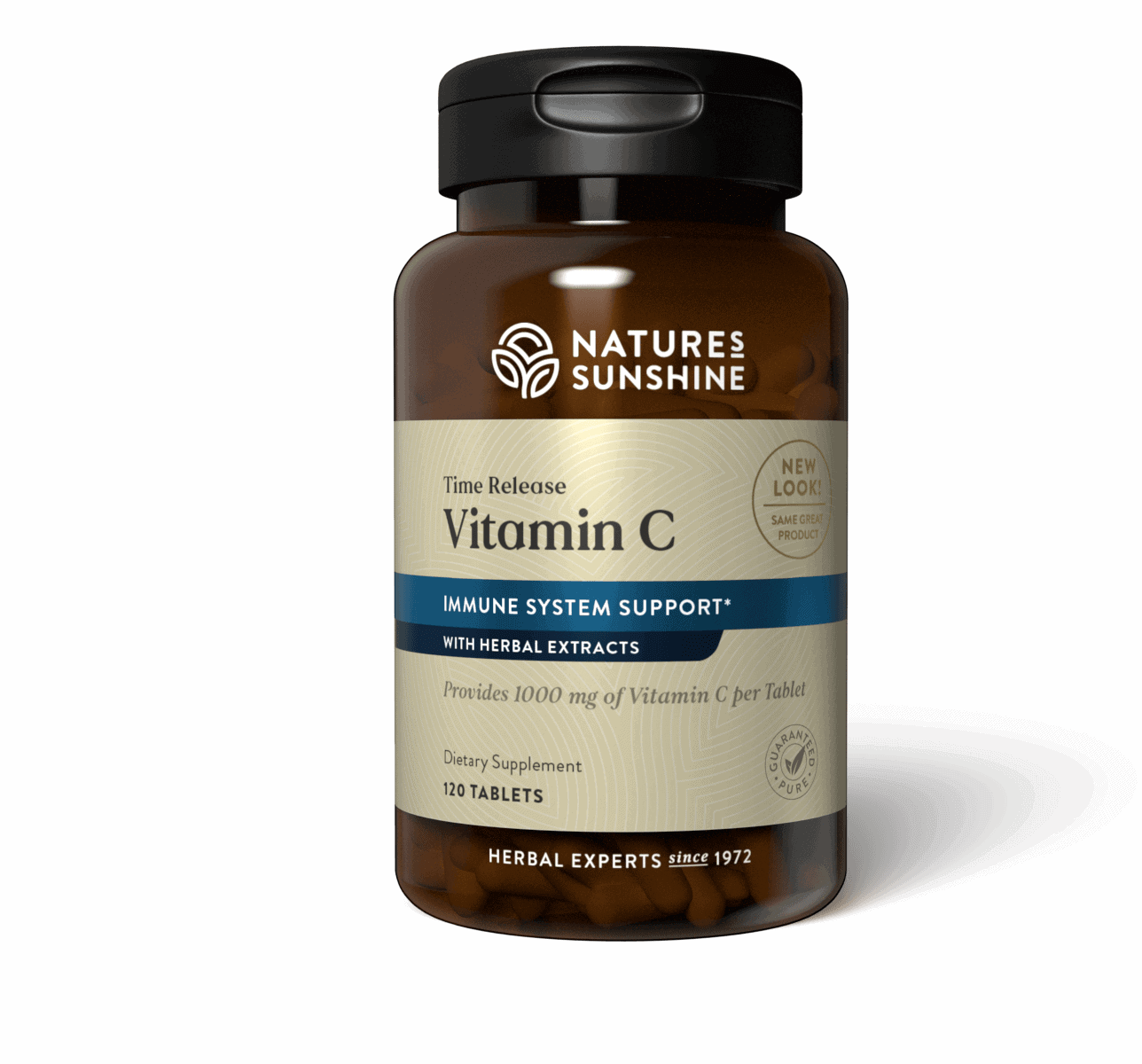
Nature's Sunshine Vitamin C Time Release is a completely natural product with no sugar, starch, artificial colorings or flavorings. It's vegan and non-GMO, making it a straightforward choice for a wide range of dietary preferences. If you have questions about whether Vitamin C supplementation fits your wellness routine, our naturopath is available for a free consultation.
Directions for Use
Take one tablet daily with a meal.
Each tablet features a special coating that slows the absorption of the nutrients until they reach the intestines, delivering the benefits of Vitamin C throughout the day rather than all at once. This time-release design reflects the fact that Vitamin C is water-soluble — approximately 70 to 90 percent of usual dietary intakes (30 to 180 mg/day) are absorbed, but absorption falls to about 50 percent or less with increasing doses above 1 g/day. Spreading absorption over time may help maintain steadier levels.
Key ingredients
- ✓ Envío gratis en pedidos superiores a $75
- ✓ Devoluciones fáciles en 90 días
- ✓ Envíos en pocas horas
Escrito por Greg Howlett
Preguntas frecuentes
Does Vitamin C prevent colds?
Research suggests that for most people, regular Vitamin C supplementation does not reduce the risk of catching a cold. A Cochrane review of 29 placebo-controlled trials involving over 11,000 participants found no effect on cold incidence in the general population. However, people exposed to brief periods of severe physical exercise — such as marathon runners and military personnel — may see a more meaningful reduction in cold risk with regular supplementation.
Can Vitamin C shorten a cold once I already have one?
Taking Vitamin C after cold symptoms have already started does not appear to be helpful based on the available therapeutic trials. The modest benefits on cold duration and severity have been observed with regular, ongoing supplementation — not with starting after you're already sick. Regular supplementation has been associated with approximately 8% shorter colds in adults and 14% shorter colds in children.
What makes this Vitamin C Time Release formula different?
Nature's Sunshine Vitamin C Time Release features a special coating that slows absorption until the nutrients reach the intestines, delivering the benefits of Vitamin C throughout the day. The Vitamin C is blended with a base of Rose hips extract, acerola extract, Rutin, Lemon bioflavonoids, and Hesperidin complex — bioflavonoid compounds that provide complementary antioxidant and immune-supportive benefits. It is vegan, non-GMO, and contains no sugar, starch, artificial colorings, or flavorings.
How much Vitamin C per day is too much?
The Institute of Medicine has set the Tolerable Upper Intake Level (UL) for adults at 2,000 mg per day. Amounts greater than this may lead to stomach upset, diarrhea, and, although rarely, kidney stones. The recommended daily allowance (RDA) is 90 mg for adult men and 75 mg for adult women, with smokers advised to add 35 mg per day.
Who benefits most from Vitamin C supplementation for colds?
Research suggests the greatest cold-related benefits are seen in individuals under high physical stress (such as endurance athletes and military personnel) and those who are Vitamin C-deficient. Children also appear to experience a larger reduction in cold duration (14%) compared to adults (8%) with regular supplementation. If you're unsure whether supplementation is right for you, our naturopath offers free consultations to help you decide.
Does Vitamin C support immunity beyond colds?
Yes. Vitamin C plays a well-documented role in both innate and adaptive immunity. Studies show it supports epithelial barrier function, enhances B-cell and T-cell differentiation and proliferation, promotes phagocytosis, normalizes cytokine production, and decreases histamine levels. It is rapidly consumed during infection, which is why plasma levels drop quickly when you're sick. Research also suggests Vitamin C may support bronchial health, sinus mucosal integrity, and post-illness recovery.
Talk to Dr. Shannyn Fowl
Not sure if this is right for you? Book a free, no-pressure consultation for personalized guidance on your health goals.
Book your free consult →About Caring Sunshine
A family-run reseller of premium supplements — free shipping, a 90-day guarantee, and real people who know the products.
Learn more about us →