
¿La cúrcuma contiene curcumina? Lo que debes saber
¿La cúrcuma contiene curcumina? Descubre cómo los curcuminoides apoyan las articulaciones, la inflamación y la defensa antioxidante.
¿La cúrcuma contiene curcumina? Cómo se relacionan ambas
Si alguna vez te has preguntado "¿la cúrcuma contiene curcumina?", la respuesta es un sí definitivo: y entender la relación entre ambas es clave para elegir el suplemento adecuado. La cúrcuma (Curcuma longa L.) es una planta herbácea perenne y rizomatosa que pertenece a la familia del jengibre, Zingiberaceae, originaria del sur de Asia tropical. Su rizoma de color amarillo dorado intenso se ha utilizado durante casi 6,000 años en distintas culturas con fines culinarios, ceremoniales y de bienestar.
Los curcuminoides son los principales compuestos activos que se obtienen del rizoma de la cúrcuma, y la curcumina (también llamada diferuloilmetano) es el curcuminoide dominante: representa aproximadamente entre un 75% y un 80% del total de curcuminoides en el extracto crudo de cúrcuma. Es el compuesto responsable del característico color amarillo de la cúrcuma, y es el foco de la mayoría de las investigaciones científicas sobre las propiedades de la cúrcuma que apoyan la salud.
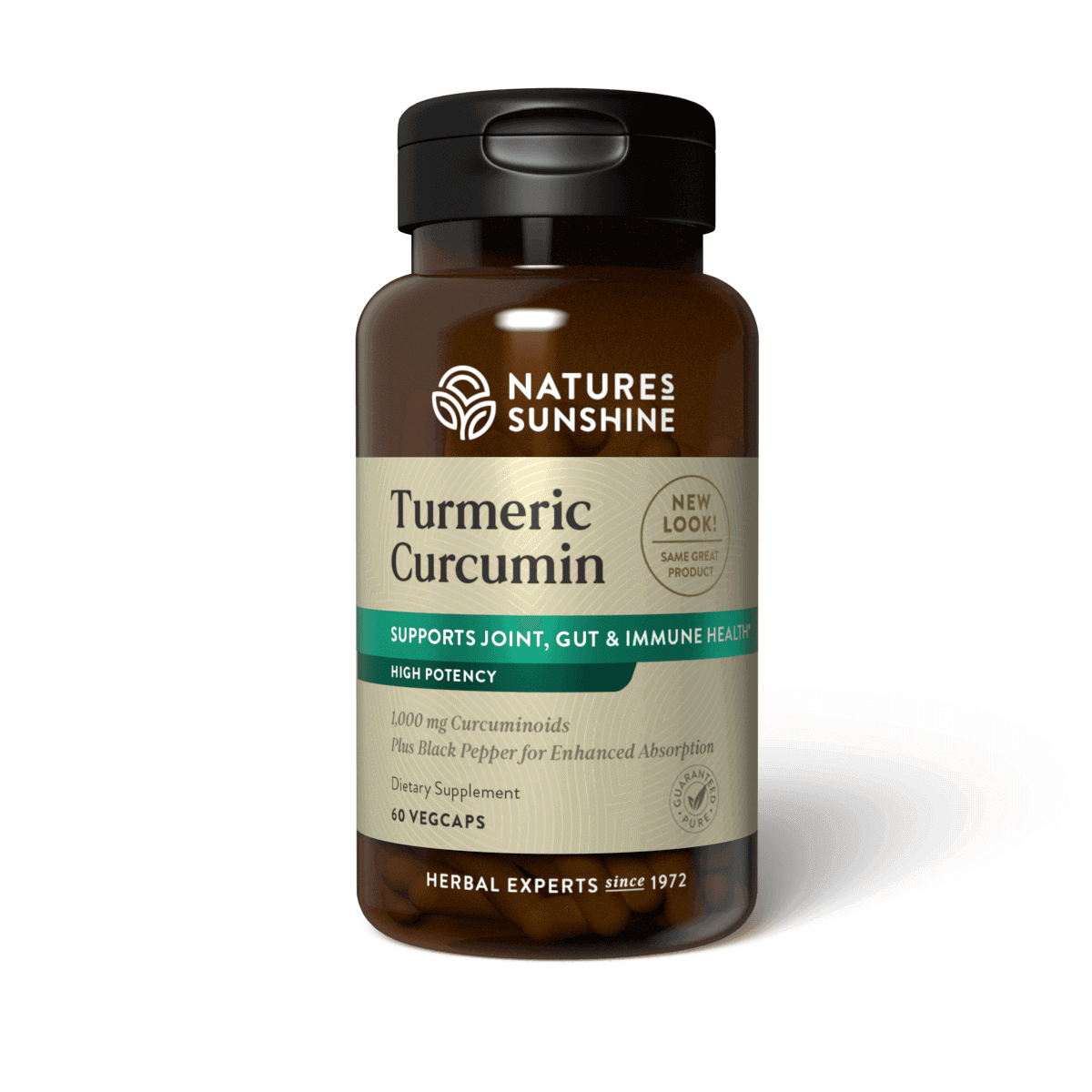
Esta es la distinción fundamental: el polvo de cúrcuma cruda suele contener solo alrededor de un 2–5% de curcuminoides en peso. Por eso necesitarías consumir cantidades muy grandes de cúrcuma común en especia para obtener niveles significativos de curcumina. Esto explica por qué los extractos estandarizados de cúrcuma —concentrados para contener un 95% o más de curcuminoides— son la forma de suplemento más común. Turmeric Curcumin de Nature's Sunshine aporta 1,100 mg de extracto de cúrcuma con 1,000 mg de curcuminoides, equivalente a 32,000 mg de cúrcuma de raíz entera en cada porción.
Por qué el contenido de curcumina en la cúrcuma es importante para tu salud
Ahora que sabes que la cúrcuma sí contiene curcumina, la siguiente pregunta es: ¿por qué es importante? Como el principal polifenol bioactivo de la cúrcuma, la curcumina se ha investigado extensamente por su capacidad de modular múltiples vías de señalización implicadas en las respuestas inflamatorias, la salud celular y el estrés oxidativo.
La investigación sugiere que la curcumina ejerce sus efectos antiinflamatorios principales sobre todo al inhibir la activación de la vía de señalización de NF-κB, regular la cascada de fosforilación de MAPK/ERK y modular la vía de JAK/STAT. También suprime la actividad de las enzimas COX-2 y LOX, que producen mediadores inflamatorios como las prostaglandinas y los leucotrienos. A través de estos mecanismos, la curcumina puede ayudar a apoyar una respuesta inflamatoria saludable en todo el cuerpo.
En cuanto a la actividad antioxidante, los estudios sugieren que la curcumina activa la vía transcripcional Keap1-Nrf2/ARE, que aumenta la expresión de enzimas citoprotectoras endógenas. Los ensayos controlados aleatorizados (ECA) en humanos y los metaanálisis han mostrado que aumenta de forma medible la capacidad antioxidante total (TAC), la superóxido dismutasa (SOD), la catalasa y el glutatión, mientras reduce el malondialdehído (MDA), un marcador de la peroxidación lipídica.
Sin embargo, una de las limitaciones más importantes para la aplicación clínica de la curcumina es su escasa biodisponibilidad oral. Debido a su baja solubilidad en agua, su escasa permeabilidad intestinal, su inestabilidad a pH alcalino y su metabolismo rápido, la curcumina estándar se absorbe mal por sí sola. Esto es precisamente lo que hace que la formulación sea tan importante: por eso Nature's Sunshine mejoró su fórmula Turmeric Curcumin con extracto de pimienta negra, que la investigación sugiere que podría aumentar la biodisponibilidad de la curcumina hasta en un 2,000%.
Si tienes dudas sobre si un suplemento Turmeric Curcumin es adecuado para tus necesidades particulares, nuestro naturópata te ofrece una consulta gratuita para ayudarte a decidir.
Qué dice la investigación sobre la curcumina de la cúrcuma
La pregunta "¿la cúrcuma contiene curcumina?" suele llevar a una indagación más profunda: ¿qué muestra realmente la ciencia? A continuación, un vistazo a las principales áreas en las que se ha estudiado la curcumina en ensayos clínicos en humanos.
Salud articular y osteoartritis
Esta es la indicación más investigada para Turmeric Curcumin. Una revisión sistemática y metaanálisis en red de 2025, con 17 estudios, observó que todas las preparaciones de cúrcuma redujeron de forma significativa las puntuaciones de dolor WOMAC en la osteoartritis de rodilla. Un metaanálisis independiente de 2022, con 29 ECA y 2,396 participantes en cinco tipos de artritis —incluidas la osteoartritis, la artritis reumatoide, la espondilitis anquilosante y la gota—, observó que la curcumina presentó posibles ventajas de eficacia y seguridad frente a los controles. Otro metaanálisis confirmó que el extracto de curcumina/cúrcuma tuvo una eficacia terapéutica similar a la de los antiinflamatorios no esteroideos (AINE), con base en 16 ECA y 1,810 adultos. Sin embargo, la calidad de la evidencia se califica de forma constante como baja o muy baja debido al tamaño reducido de las muestras y a la heterogeneidad metodológica.
Respuesta inflamatoria
Múltiples metaanálisis de ECA han mostrado reducciones significativas en biomarcadores inflamatorios clave —incluidos la PCR, la IL-6 y el TNF-α— tras la suplementación con curcumina. Una revisión de 2024, que incluyó 54 metaanálisis, observó reducciones de la PCR en siete de los diez metaanálisis y una disminución significativa de la IL-6 en cinco de los ocho metaanálisis revisados. La evidencia es genuina, pero está condicionada por las limitaciones de biodisponibilidad de la curcumina.
Salud metabólica
Una revisión sistemática y metaanálisis de 2025 observó que la suplementación con curcumina redujo de forma significativa la glucemia en ayunas, la HbA1c, los triglicéridos y el colesterol LDL, mientras elevó el colesterol HDL y la capacidad antioxidante total en personas con síndrome metabólico y diabetes tipo 2. Los tamaños del efecto fueron modestos y la heterogeneidad fue de moderada a alta.
Apoyo cognitivo
La evidencia preclínica de los efectos neuroprotectores de la curcumina es extensa e incluye mecanismos antiamiloide, antitau, de restauración del BDNF y de supresión de la neuroinflamación. En un estudio, tomar 1,500 mg al día de una formulación de curcumina a base de aceite de cúrcuma durante 12 meses estabilizó la función cognitiva en adultos mayores en comparación con el placebo. Sin embargo, la totalidad de la evidencia clínica sigue en una etapa temprana.
Salud digestiva
La evidencia de los ECA sugiere que la curcumina podría ser una terapia complementaria eficaz en la colitis ulcerosa (CU), principalmente para mantener o lograr la remisión. Un metaanálisis de 2025, con 13 ECA controlados con placebo, mostró una eficacia significativa de la curcumina para lograr la remisión clínica y la respuesta en pacientes con CU.
Ingredientes clave
- ✓ Envío gratis en pedidos superiores a $75
- ✓ Devoluciones fáciles en 90 días
- ✓ Envíos en pocas horas
Quién debería considerar un suplemento Turmeric Curcumin
Saber que la cúrcuma sí contiene curcumina es el primer paso; el segundo es reconocer si un suplemento concentrado de curcumina podría ser adecuado para ti. Según la investigación, esta fórmula puede ser especialmente relevante para:
- Adultos preocupados por la comodidad articular: especialmente quienes experimentan rigidez o molestias ocasionales relacionadas con el desgaste cotidiano. Múltiples metaanálisis respaldan el uso de la curcumina para el dolor y la función en la osteoartritis de rodilla.
- Quienes buscan apoyo antioxidante: la capacidad de la curcumina para aumentar la capacidad antioxidante total y reducir los marcadores de estrés oxidativo se ha demostrado en múltiples ECA.
- Personas que desean favorecer una respuesta inflamatoria saludable: la curcumina actúa sobre múltiples vías proinflamatorias y ha mostrado reducciones significativas en biomarcadores inflamatorios como la PCR, la IL-6 y el TNF-α en estudios clínicos.
- Personas interesadas en un apoyo más integral para el bienestar: la investigación preliminar también sugiere que la curcumina podría apoyar la salud cerebral, intestinal, de la piel y del sistema inmunitario.
Esta fórmula no contiene ingredientes modificados genéticamente y se presenta en VegCaps, lo que la hace adecuada para quienes prefieren cápsulas a base de plantas. Si tienes dudas sobre si Turmeric Curcumin es adecuado para tu situación —sobre todo si tomas medicamentos, ya que la curcumina y la piperina pueden afectar la forma en que se metabolizan ciertos fármacos—, nuestro naturópata ofrece consultas gratuitas para ayudarte a decidir.
Modo de uso de Turmeric Curcumin de Nature's Sunshine
Toma 2 VegCaps al día. Cada porción aporta 1,100 mg de extracto de cúrcuma con 1,000 mg de curcuminoides —equivalente a 32,000 mg de cúrcuma de raíz entera— junto con extracto de pimienta negra para apoyar la absorción.
La inclusión del extracto de pimienta negra es importante: dado que la curcumina tiene una biodisponibilidad inherentemente baja debido a su baja solubilidad en agua, su metabolismo rápido y su rápida eliminación sistémica, la piperina del extracto de pimienta negra ayuda a inhibir las enzimas que de otro modo descompondrían rápidamente la curcumina antes de que tu cuerpo pueda aprovecharla.
Cada frasco contiene 60 cápsulas, lo que proporciona un suministro para 30 días según la porción recomendada.
Escrito por Greg Howlett
Preguntas frecuentes
¿La cúrcuma contiene curcumina de forma natural?
Sí. La curcumina es el curcuminoide dominante presente de forma natural en el rizoma de la cúrcuma (Curcuma longa L.). Sin embargo, el polvo de cúrcuma cruda contiene solo alrededor de un 2–5% de curcuminoides en peso. Por eso los extractos estandarizados de cúrcuma —concentrados a un 95% o más de curcuminoides— son la forma más común utilizada en los suplementos, ya que aportan mucha más curcumina por porción que la especia de cúrcuma culinaria.
¿Cuál es la diferencia entre la cúrcuma y la curcumina?
La cúrcuma es el rizoma completo de la planta (Curcuma longa), que contiene más de 235 fitoquímicos identificados, entre ellos curcuminoides, aceites volátiles, azúcares, proteínas y resinas. La curcumina es el curcuminoide principal —un compuesto polifenólico específico dentro de la cúrcuma— que representa aproximadamente entre un 75% y un 80% del total de curcuminoides y es responsable del color amarillo de la cúrcuma. La mayor parte de la investigación clínica sobre los beneficios de la cúrcuma para la salud se centra específicamente en la curcumina.
¿Por qué se incluye pimienta negra en esta fórmula Turmeric Curcumin?
La curcumina tiene una biodisponibilidad oral inherentemente baja debido a su baja solubilidad en agua, su escasa permeabilidad intestinal y su metabolismo rápido. La piperina, el alcaloide activo de la pimienta negra, inhibe las enzimas CYP3A4, glicoproteína P y UGT, que de otro modo metabolizarían rápidamente la curcumina. En un estudio en humanos, la coadministración de piperina con curcumina aumentó las concentraciones sanguíneas de curcumina en un 2,000%. El extracto de pimienta negra también podría ofrecer propiedades antiinflamatorias y antioxidantes propias.
¿Qué dice la investigación sobre la curcumina y la salud articular?
La salud articular —en particular la osteoartritis de rodilla— es la indicación más investigada para la curcumina. Un metaanálisis en red de 2025, con 17 estudios, observó que todas las preparaciones de cúrcuma redujeron de forma significativa el dolor por osteoartritis. Un metaanálisis de 2022, con 29 ECA en cinco tipos de artritis, confirmó la posible eficacia de la curcumina, y un metaanálisis independiente de 16 ECA observó que la curcumina fue comparable a los AINE. Sin embargo, la calidad de la evidencia se califica de forma constante como baja o muy baja, y los investigadores señalan la necesidad de más estudios.
¿Cuánta curcumina contiene una porción de este producto?
Cada porción (2 VegCaps) aporta 1,100 mg de extracto de cúrcuma con 1,000 mg de curcuminoides, lo que equivale a 32,000 mg de cúrcuma de raíz entera según el fabricante. La fórmula también incluye extracto de pimienta negra para apoyar la biodisponibilidad.
¿Existen consideraciones de seguridad con los suplementos Turmeric Curcumin?
La curcumina está reconocida por la FDA como generalmente reconocida como segura (GRAS), y se ha descrito como segura en dosis de hasta 6 g al día durante 4 a 7 semanas en ensayos clínicos. Los efectos secundarios más descritos son alteraciones gastrointestinales leves, como náuseas y diarrea. Sin embargo, existe un riesgo poco frecuente de daño hepático, que podría ser mayor con fórmulas que potencian la biodisponibilidad o con dosis más altas. Debido a que la piperina inhibe ciertas enzimas que metabolizan fármacos, podría interactuar con medicamentos administrados de forma conjunta. Si tomas medicamentos con receta o tienes alguna preocupación hepática existente, consulta a un profesional de la salud; nuestro naturópata también te ofrece una consulta gratuita.
Talk to Dr. Shannyn Fowl
Not sure if this is right for you? Book a free, no-pressure consultation for personalized guidance on your health goals.
Book your free consult →About Caring Sunshine
A family-run reseller of premium supplements — free shipping, a 90-day guarantee, and real people who know the products.
Learn more about us →