
Diferencia entre cúrcuma y curcumina explicada
Conoce la diferencia entre cúrcuma y curcumina, cómo actúan juntas para apoyar las articulaciones y la inflamación, y por qué importa la biodisponibilidad.
¿Cuál es la diferencia entre la cúrcuma y la curcumina?
Si alguna vez has buscado suplementos para la comodidad articular o el apoyo frente a la inflamación, es probable que hayas visto tanto "cúrcuma" como "curcumina" en las etiquetas: a veces en el mismo producto. Entender la diferencia entre la cúrcuma y la curcumina es clave para elegir el suplemento adecuado para tus necesidades.
La cúrcuma es la especia entera: el rizoma (tallo subterráneo) seco y molido de Curcuma longa, una planta de la familia del jengibre que se ha usado durante casi 6,000 años en la medicina tradicional ayurvédica, china y del sudeste asiático. Históricamente, la cúrcuma se usó para trastornos digestivos, afecciones inflamatorias, infecciones de la piel, cicatrización de heridas y afecciones respiratorias. Contiene una matriz compleja de más de 235 fitoquímicos identificados, entre ellos aceites volátiles (turmeronas), proteínas, azúcares y resinas.
La curcumina, en cambio, es un compuesto específico dentro de la cúrcuma. Es el curcuminoide principal: un polifenol de color amarillo brillante (específicamente un diarilheptanoide) aislado por primera vez en 1815 y caracterizado estructuralmente en 1910. La curcumina de calidad alimentaria normalmente consiste en aproximadamente un 77% de curcumina (también llamada curcumina I o diferuloilmetano), un 17% de demetoxicurcumina y un 3% de bisdemetoxicurcumina. La raíz cruda de cúrcuma contiene solo alrededor de un 2–5% de curcuminoides en peso, por eso los extractos estandarizados de cúrcuma concentran el contenido de curcuminoides —a menudo hasta un 95–98%— para su uso en suplementos.
En resumen: la cúrcuma es el material vegetal completo; la curcumina es su ingrediente activo más investigado. Un suplemento de calidad por lo general aporta tanto la raíz entera de cúrcuma como un extracto concentrado de cúrcuma rico en curcuminoides, de modo que obtienes todo el espectro de los compuestos tradicionales de la cúrcuma junto con niveles significativos de la curcumina bioactiva en la que se ha centrado la investigación.
Cómo actúan juntas la cúrcuma y la curcumina
Debido a que la raíz de cúrcuma contiene naturalmente un porcentaje tan pequeño de curcuminoides, simplemente agregar cúrcuma en polvo a tus alimentos —aunque es una tradición culinaria maravillosa— puede no aportar suficiente curcumina como para apoyar de manera significativa una respuesta inflamatoria saludable. Esta es una de las razones por las que la diferencia entre la cúrcuma y la curcumina importa tanto en el contexto de los suplementos.
La curcumina se ha estudiado extensamente por su capacidad de modular múltiples vías de señalización implicadas en la inflamación. La investigación sugiere que puede inhibir la vía de señalización de NF-κB, suprimir las enzimas COX-2 y LOX responsables de producir prostaglandinas y leucotrienos inflamatorios, y reducir la producción de citocinas inflamatorias como el TNF-α y la IL-1β. También activa la vía transcripcional Keap1-Nrf2/ARE, lo que aumenta la expresión de las propias enzimas de defensa antioxidante del cuerpo.
Sin embargo, la curcumina enfrenta un desafío bien documentado: su baja biodisponibilidad oral. Su baja solubilidad en agua, su inestabilidad a pH alcalino y su metabolismo rápido hacen que muy poca curcumina llegue a la circulación sistémica tras una dosis oral. Un estudio en animales mostró que la absorción oral fue de solo alrededor de un 1% en comparación con la administración intravenosa. Esta brecha de biodisponibilidad se cita ampliamente como el factor principal que limita la aplicación clínica de la curcumina.
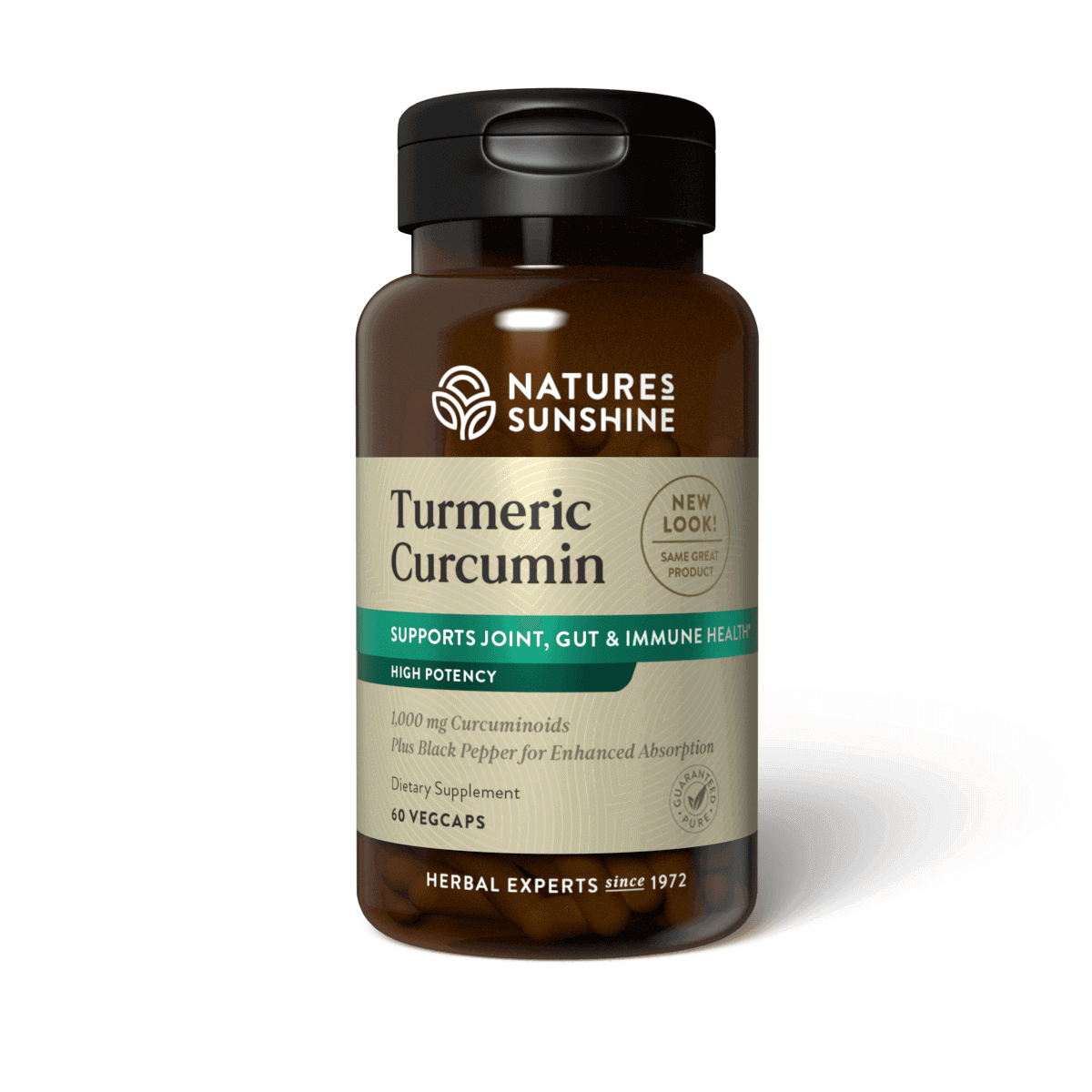
Aquí es donde una formulación bien pensada hace una diferencia real. Turmeric Curcumin de Nature's Sunshine aporta tanto raíz de cúrcuma como niveles más altos de extracto de cúrcuma rico en antioxidantes, y proporciona 1,100 mg de extracto de cúrcuma y 1,000 mg de curcuminoides por porción. También incluye extracto de pimienta negra (de Piper nigrum), que contiene piperina: un alcaloide que, según estudios en humanos, aumenta la biodisponibilidad de la curcumina en aproximadamente un 2,000% al inhibir las enzimas de glucuronidación que eliminan rápidamente la curcumina del cuerpo.
Cúrcuma y curcumina para las articulaciones, la inflamación y la defensa antioxidante
El área con la evidencia clínica en humanos más extensa para la cúrcuma y la curcumina es la salud musculoesquelética: en particular, la osteoartritis de rodilla. Múltiples revisiones sistemáticas y metaanálisis de ensayos controlados aleatorizados (ECA) han mostrado que los preparados de cúrcuma y curcumina pueden reducir de manera significativa el dolor articular y la rigidez, y mejorar la función física en comparación con el placebo. Un metaanálisis en red de 2025 que incluyó 17 estudios observó que todos los preparados de cúrcuma redujeron de manera significativa las puntuaciones de dolor de la escala WOMAC. Un metaanálisis independiente de 2022 de 29 ECA con 2,396 participantes y cinco tipos de artritis también confirmó estos hallazgos, y un metaanálisis de 16 ECA halló que la eficacia del tratamiento con curcumina era comparable a la de los antiinflamatorios no esteroideos (AINE). Sin embargo, la certeza de esta evidencia se califica de manera constante como baja a muy baja debido al tamaño pequeño de las muestras, la variabilidad metodológica y la frecuente participación de la industria en los estudios.
En cuanto a la inflamación crónica en un sentido más amplio, la investigación sugiere que la curcumina puede reducir biomarcadores inflamatorios clave. Una revisión sistemática y metaanálisis de 2025 de ECA que evaluó la curcumina en el síndrome metabólico observó que redujo de manera significativa la proteína C reactiva (PCR), el TNF-α y la IL-6. Una revisión de 2024 de 54 metaanálisis señaló que se observaron reducciones de la PCR en siete de los diez metaanálisis examinados. Aun así, una revisión sistemática de 2019 de 19 ECA no halló una reducción estadísticamente significativa en los marcadores inflamatorios circulantes, lo que refleja un debate científico en curso. La baja biodisponibilidad oral sigue siendo el factor principal que limita la consistencia de los resultados clínicos.
Como antioxidante, la curcumina ha mostrado actividad en múltiples ECA en humanos, pues aumenta de manera medible la capacidad antioxidante total (CAT), la superóxido dismutasa (SOD), la catalasa y el glutatión, mientras reduce el malondialdehído (MDA), un marcador de la peroxidación lipídica. El mecanismo principal es la activación de la vía de señalización Nrf2-Keap1.
La investigación también sugiere posibles beneficios para la salud cerebral, la salud intestinal y la función inmunitaria. En un estudio, 1,500 mg/día de una formulación de curcumina durante 12 meses estabilizó la función cognitiva en adultos mayores en comparación con el placebo. Un metaanálisis de 2025 de 13 ECA observó que la curcumina mostró una eficacia significativa para lograr la remisión clínica en pacientes con colitis ulcerosa. Múltiples metaanálisis han descrito mejoras en los marcadores glucémicos y lipídicos en personas con síndrome metabólico y diabetes tipo 2. Estas áreas son prometedoras, aunque en muchos casos la totalidad de la evidencia clínica sigue en una etapa temprana.
Ingredientes clave
- ✓ Envío gratis en pedidos superiores a $75
- ✓ Devoluciones fáciles en 90 días
- ✓ Envíos en pocas horas
Quién puede beneficiarse de un suplemento de cúrcuma y curcumina
Ahora que entiendes la diferencia entre la cúrcuma y la curcumina, es posible que te preguntes si un suplemento como Turmeric Curcumin de Nature's Sunshine es adecuado para ti. Esta fórmula está diseñada para adultos que desean apoyar:
- La comodidad y flexibilidad articular: en especial para quienes presentan rigidez ocasional o molestias articulares relacionadas con la edad
- Una respuesta inflamatoria saludable: la investigación sugiere que la curcumina puede ayudar a modular vías inflamatorias clave
- La defensa antioxidante: se ha demostrado que la curcumina aumenta las enzimas antioxidantes endógenas en ensayos clínicos
- El bienestar general: con investigaciones que exploran beneficios para la salud cerebral, la salud intestinal, la salud de la piel y la función inmunitaria
Este producto no contiene organismos genéticamente modificados (OGM), viene en VegCaps y no requiere membresía ni envío automático para comprarlo. Si tienes dudas sobre si Turmeric Curcumin es adecuado para tus necesidades de salud particulares, nuestro naturópata te ofrece una consulta gratuita: un servicio que ofrecemos desde que nuestra familia fundó esta tienda en 1999.
Una porción de esta fórmula equivale a 32,000 mg de raíz entera de cúrcuma, y el producto cuenta con estudios clínicos que respaldan su absorción y eficacia superiores. La inclusión de extracto de pimienta negra está diseñada específicamente para abordar el reto bien documentado de la biodisponibilidad de la curcumina.
Cómo tomar Turmeric Curcumin de Nature's Sunshine
Toma 2 VegCaps al día. Cada frasco contiene 60 cápsulas, lo que proporciona un suministro para 30 días según la porción recomendada de 2 cápsulas.
Como con cualquier suplemento dietético, vale la pena mencionar algunas consideraciones de seguridad importantes a partir de la bibliografía científica. Se ha descrito que la curcumina es segura en dosis de hasta 6 gramos al día durante 4 a 7 semanas en ensayos clínicos, y la FDA le ha otorgado a la curcumina el estatus GRAS como ingrediente alimentario. Los efectos gastrointestinales —como náuseas, diarrea o malestar estomacal ocasionales— son los efectos secundarios descritos con mayor frecuencia en los ensayos clínicos, en especial con dosis más altas.
Debido a que la piperina (proveniente del extracto de pimienta negra) inhibe ciertas enzimas que metabolizan medicamentos, incluidas la CYP3A4 y la glucoproteína P, las personas que toman medicamentos con receta —en especial anticoagulantes, carbamazepina u otros sustratos de la CYP3A4— deben consultar a un profesional de la salud antes de usarlo. Si tienes dudas sobre posibles interacciones con tus medicamentos actuales, nuestro naturópata puede ayudarte con una consulta gratuita.
Escrito por Greg Howlett
Preguntas frecuentes
¿Cuál es la principal diferencia entre la cúrcuma y la curcumina?
La cúrcuma es el rizoma (raíz) entero y seco de la planta <em>Curcuma longa</em>: una especia compleja que contiene más de 235 fitoquímicos identificados, entre ellos aceites volátiles, proteínas y resinas. La curcumina es un compuesto polifenólico específico dentro de la cúrcuma y es el curcuminoide bioactivo más investigado. La cúrcuma cruda contiene solo alrededor de un 2–5% de curcuminoides en peso, por eso los suplementos usan extractos estandarizados para concentrar los niveles de curcumina. Turmeric Curcumin de Nature's Sunshine aporta tanto raíz de cúrcuma como niveles más altos de extracto concentrado de cúrcuma, con 1,000 mg de curcuminoides por porción.
¿Por qué se incluye la pimienta negra en un suplemento de cúrcuma y curcumina?
La curcumina tiene una biodisponibilidad oral notoriamente baja: su baja solubilidad en agua, su inestabilidad a pH alcalino y su metabolismo rápido hacen que muy poca llegue por sí sola a la circulación sistémica. Se ha demostrado en estudios en humanos que la piperina, el alcaloide activo de la pimienta negra, aumenta la biodisponibilidad de la curcumina en aproximadamente un 2,000% al inhibir las enzimas de glucuronidación y la CYP3A4 que normalmente eliminan la curcumina del cuerpo. El extracto de pimienta negra de esta fórmula se incluye específicamente para abordar este reto de absorción bien documentado.
¿Qué dice la investigación sobre la curcumina y la salud articular?
La osteoartritis de rodilla es la indicación más investigada para la curcumina en ensayos clínicos en humanos. Múltiples revisiones sistemáticas y metaanálisis de ECA han mostrado que los preparados de cúrcuma y curcumina pueden reducir de manera significativa el dolor y la rigidez, y mejorar la función física en comparación con el placebo. Algunos metaanálisis han hallado que la eficacia de la curcumina es comparable a la de los AINE. Sin embargo, la certeza de la evidencia se califica de manera constante como baja a muy baja debido al tamaño pequeño de las muestras, el alto riesgo de sesgo y la heterogeneidad metodológica entre los estudios.
¿Puedo obtener suficiente curcumina al cocinar con cúrcuma?
Aunque agregar cúrcuma a los alimentos es una tradición culinaria maravillosa que se ha usado durante miles de años, la cúrcuma en polvo contiene solo alrededor de un 2–5% de curcuminoides en peso. Una porción de Turmeric Curcumin de Nature's Sunshine equivale a 32,000 mg de raíz entera de cúrcuma, y aporta 1,000 mg de curcuminoides: una concentración difícil de lograr solo con la alimentación. La adición de extracto de pimienta negra mejora aún más la absorción, más allá de lo que normalmente obtendrías de una comida.
¿Existen problemas de seguridad con los suplementos de cúrcuma y curcumina?
Se ha descrito que la curcumina es segura en dosis de hasta 6 gramos al día durante 4 a 7 semanas en ensayos clínicos, y la FDA le ha otorgado el estatus GRAS. Los efectos secundarios más comunes son problemas gastrointestinales leves, como náuseas o diarrea, en especial con dosis más altas. Sin embargo, debido a que la piperina inhibe ciertas enzimas que metabolizan medicamentos (CYP3A4, glucoproteína P), las personas que toman medicamentos con receta deben consultar a un profesional de la salud antes de usarlo. También se ha descrito un riesgo poco frecuente de daño hepático con suplementos de cúrcuma con biodisponibilidad mejorada, en especial con dosis más altas. Nuestro naturópata te ofrece una consulta gratuita si tienes dudas sobre las interacciones con tus medicamentos actuales.
¿En qué se diferencia este producto de otros suplementos de cúrcuma?
Mientras que la mayoría de los productos de cúrcuma aportan niveles altos de raíz de cúrcuma básica con niveles bajos de extracto concentrado de cúrcuma, Turmeric Curcumin de Nature's Sunshine aporta tanto raíz de cúrcuma como niveles más altos de extracto de cúrcuma rico en antioxidantes, con 1,100 mg de extracto de cúrcuma y 1,000 mg de curcuminoides por porción. La fórmula no contiene organismos genéticamente modificados (OGM), cuenta con estudios clínicos que respaldan su absorción y eficacia superiores, y está potenciada con extracto de pimienta negra para mejorar la biodisponibilidad. Viene en VegCaps, sin necesidad de envío automático ni membresía.
Talk to Dr. Shannyn Fowl
Not sure if this is right for you? Book a free, no-pressure consultation for personalized guidance on your health goals.
Book your free consult →About Caring Sunshine
A family-run reseller of premium supplements — free shipping, a 90-day guarantee, and real people who know the products.
Learn more about us →