
Curcumina vs. cúrcuma: diferencias clave
Descubre las diferencias entre curcumina y cúrcuma, su importancia para la inflamación y las articulaciones, y qué buscar en un suplemento de calidad.
Curcumina vs. cúrcuma: ¿cuál es la diferencia y por qué importa?
Si alguna vez has comprado un suplemento de cúrcuma, es probable que te hayas encontrado con la pregunta de curcumina vs. cúrcuma. Los dos términos se usan a menudo indistintamente, pero no son lo mismo: entender la diferencia puede ayudarte a tomar una decisión más informada para tus articulaciones, tu sistema inmunitario y tu bienestar general.
La cúrcuma (Curcuma longa L.) es una planta herbácea perenne y rizomatosa que pertenece a la familia del jengibre, Zingiberaceae, originaria del sur de Asia tropical. El rizoma seco y molido es lo que la mayoría conocemos como la especia dorada usada en curris y en la medicina tradicional desde hace casi 6,000 años. La cúrcuma contiene una matriz rica de compuestos: más de 235 fitoquímicos identificados, entre ellos terpenoides, aceites volátiles (como la turmerona), azúcares, proteínas y resinas.
La curcumina —llamada con mayor precisión diferuloylmethane— es el curcuminoide dominante dentro de la cúrcuma, el polifenol de color amarillo intenso responsable tanto del color vibrante de la especia como de la mayor parte de su actividad biológica respaldada por la investigación. Por lo general representa entre un 75 y un 80% del total de curcuminoides en un extracto crudo de cúrcuma, aunque los curcuminoides en sí solo constituyen alrededor de un 2–5% del peso de la raíz entera.
En otras palabras, la cúrcuma es el material vegetal entero; la curcumina es el compuesto bioactivo específico que se extrae de ella. Una cucharadita de cúrcuma molida aporta solo una pequeña cantidad de curcumina, lo que es una de las razones por las que los extractos estandarizados —concentrados para ofrecer un contenido constante de curcuminoides— se han convertido en el centro tanto de la investigación clínica como de la suplementación.
Por qué la curcumina atrae la atención de la investigación, y por qué la cúrcuma sigue siendo importante
La conversación de curcumina vs. cúrcuma gira, en última instancia, en torno a la potencia y la absorción. La investigación sugiere que la curcumina ejerce sus principales efectos antiinflamatorios sobre todo al inhibir la activación de la vía de señalización NF-κB, regular la cascada de fosforilación MAPK/ERK y modular la vía JAK/STAT. También suprime las enzimas COX-2 y LOX, responsables de producir prostaglandinas y leucotrienos: mediadores inflamatorios clave. En cuanto al efecto antioxidante, la curcumina activa la vía transcripcional Keap1-Nrf2/ARE, que aumenta la expresión de enzimas citoprotectoras endógenas.
Sin embargo, la curcumina enfrenta un desafío farmacocinético bien documentado: una baja biodisponibilidad oral. Numerosos factores —entre ellos la baja solubilidad en agua, la escasa permeabilidad intestinal, la inestabilidad a pH alcalino y el metabolismo rápido— contribuyen a esta limitación. Un estudio en animales mostró que la absorción oral de curcumina fue de solo alrededor de un 1% en comparación con la administración intravenosa.
Aquí es donde cobran importancia la matriz de la raíz entera de cúrcuma y los potenciadores de la biodisponibilidad. La estrategia más estudiada para mejorar la absorción es la coadministración con piperina, el alcaloide activo de la pimienta negra. En un estudio humano de referencia, la biodisponibilidad de la curcumina aumentó en un 2,000% a los 45 minutos de coadministrar curcumina por vía oral con piperina. Aun así, investigaciones farmacocinéticas independientes señalan que, incluso con formulaciones mejoradas, los niveles plasmáticos de curcumina pueden seguir estando por debajo de las concentraciones usadas en estudios de laboratorio: una advertencia que vale la pena tener en cuenta al evaluar cualquier producto de cúrcuma o curcumina.
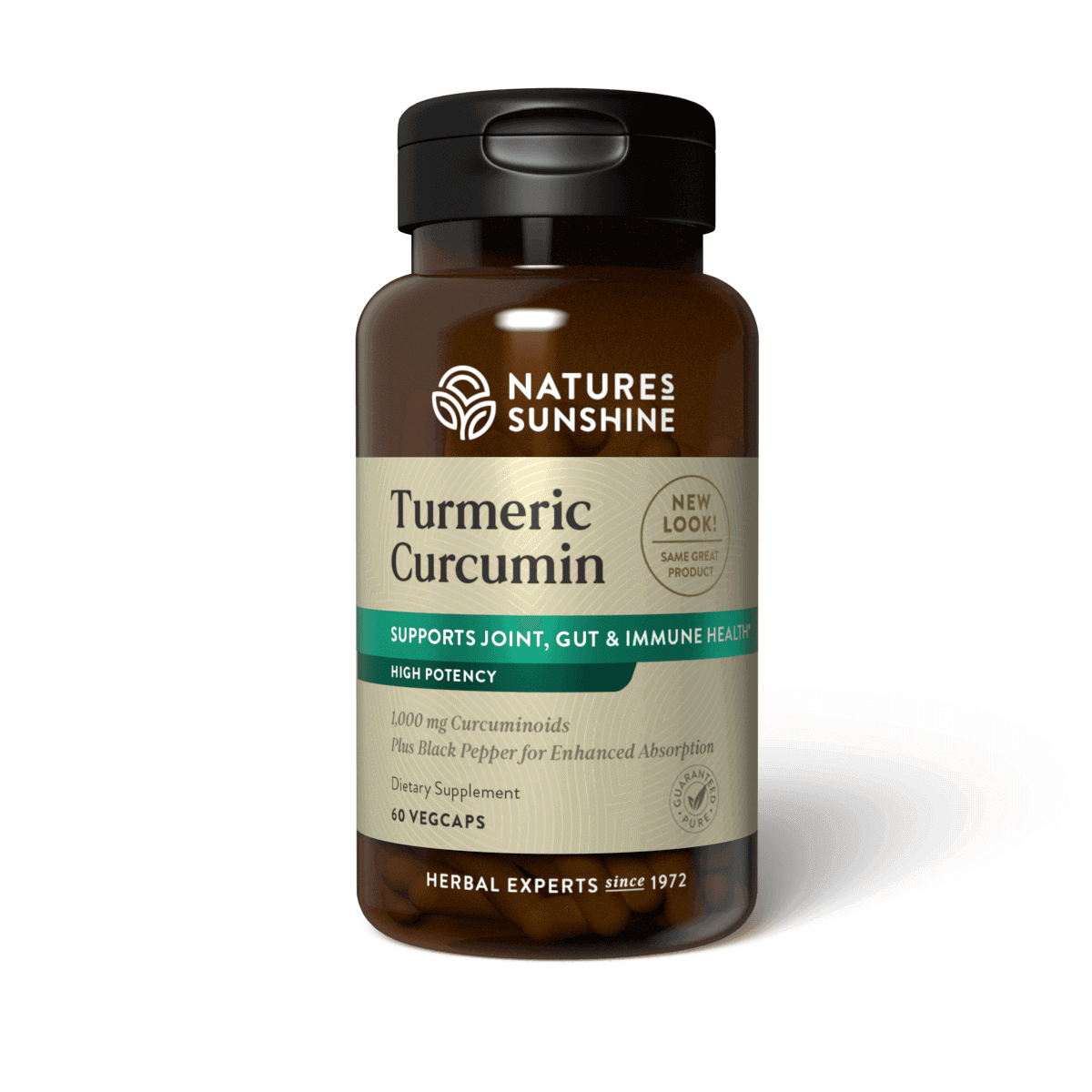
Turmeric Curcumin de Nature's Sunshine aborda ambos aspectos de la ecuación curcumina vs. cúrcuma. En lugar de aportar solo una cantidad modesta de extracto de cúrcuma junto con raíz de cúrcuma cruda, esta fórmula ofrece niveles más altos de extracto de cúrcuma rico en antioxidantes junto con raíz de cúrcuma, además de extracto de pimienta negra para apoyar la absorción. Una porción equivale a 32,000 mg de cúrcuma en raíz entera.
Inflamación, articulaciones y más: la evidencia sobre la curcumina y la cúrcuma
La osteoartritis —particularmente la osteoartritis de rodilla— es la indicación más investigada para la curcumina en ensayos clínicos en humanos. Una revisión sistemática y metaanálisis en red de 2025, que incluyó 17 estudios, observó que todas las preparaciones de cúrcuma redujeron de forma significativa las puntuaciones de dolor WOMAC en comparación con placebo, y una preparación con biodisponibilidad mejorada mostró una reducción del 30% que alcanzó el umbral de diferencia mínima clínicamente importante. Un metaanálisis independiente de 2022, con 29 ensayos controlados aleatorizados (ECA) y 2,396 participantes en cinco tipos de artritis, confirmó la eficacia de la curcumina, y otro metaanálisis de 16 ECA observó una eficacia similar a la de los antiinflamatorios no esteroideos (AINE). Sin embargo, la calidad de la evidencia en estas revisiones se califica de manera consistente como baja a muy baja, debido al tamaño reducido de las muestras, el alto riesgo de sesgo y la heterogeneidad de las formulaciones.
Más allá de las articulaciones, el conjunto de la evidencia de metaanálisis respalda un efecto beneficioso de la curcumina sobre múltiples marcadores cardiometabólicos. Una revisión sistemática y metaanálisis de 2025 observó que la suplementación con curcumina redujo de forma significativa la glucosa en ayunas, la HbA1c, los triglicéridos y el colesterol LDL, mientras elevaba el colesterol HDL y la capacidad antioxidante total. También atenuó la inflamación sistémica, al reducir la proteína C reactiva, el TNF-α y la IL-6. Los tamaños del efecto son modestos, y la calidad de la evidencia varía de baja a moderada.
La investigación también sugiere que la curcumina podría ser una terapia complementaria eficaz en la colitis ulcerosa. Un metaanálisis de 2025, con 13 ECA controlados con placebo, mostró una eficacia significativa para lograr la remisión clínica y la respuesta en pacientes con colitis ulcerosa, aunque la heterogeneidad en las formulaciones y las dosis limita las conclusiones firmes. La evidencia para la enfermedad de Crohn es más limitada: un ECA observó que la curcumina oral no fue más eficaz que el placebo para prevenir la recurrencia posquirúrgica de la enfermedad de Crohn.
Datos preliminares de ensayos clínicos en humanos sugieren posibles beneficios en el envejecimiento cognitivo y el estado de ánimo. Un estudio observó que 1,500 mg/día de una formulación de curcumina a base de aceite de cúrcuma, durante 12 meses, estabilizó la función cognitiva en adultos mayores en comparación con placebo. Se ha demostrado que la suplementación con curcumina restaura los niveles del factor neurotrófico derivado del cerebro (BDNF) y mitiga la neuroinflamación en modelos preclínicos. Sin embargo, la totalidad de la evidencia clínica sobre los resultados cognitivos sigue siendo preliminar, con la mayoría de los ensayos de tamaño pequeño y corta duración.
Es importante tener en cuenta que las concentraciones que han mostrado ejercer efectos biológicos en entornos de laboratorio podrían no alcanzarse por completo en la circulación humana tras la administración oral, incluso con formulaciones mejoradas. La evidencia es realmente prometedora para el apoyo articular y la actividad antiinflamatoria, pero interpretarla requiere tener en cuenta estas limitaciones del mundo real. Si tienes dudas sobre si un suplemento de cúrcuma o curcumina es adecuado para tu situación, nuestro naturópata te ofrece una consulta gratuita.
Ingredientes clave
- ✓ Envío gratis en pedidos superiores a $75
- ✓ Devoluciones fáciles en 90 días
- ✓ Envíos en pocas horas
¿Quién debería considerar un suplemento de cúrcuma y curcumina?
Entender la distinción de curcumina vs. cúrcuma te ayuda a comprender por qué esta fórmula se diseñó de esta manera y a quién puede servirle mejor. Turmeric Curcumin de Nature's Sunshine está formulado para adultos que buscan apoyar una respuesta inflamatoria saludable, en particular quienes se preocupan por la comodidad articular, la rigidez y la movilidad.
La investigación sugiere que podría ser especialmente relevante para personas que presentan molestias articulares ocasionales, quienes buscan apoyo antioxidante, o cualquiera interesado en favorecer la función del sistema inmunitario y la salud intestinal. La combinación de raíz de cúrcuma y niveles más altos de extracto de cúrcuma de esta fórmula —potenciada con pimienta negra para la absorción— la convierte en una opción interesante para quienes buscan más de lo que puede ofrecer un polvo de cúrcuma básico.
Debido a que la curcumina se ha usado de forma segura durante siglos en la medicina ayurvédica de la India y está reconocida por la FDA como GRAS, presenta un perfil de seguridad bien establecido en las dosis estándar de suplementación. Sin embargo, las personas que toman medicamentos anticoagulantes o antiplaquetarios, quienes tienen afecciones hepáticas existentes, o cualquiera que tome medicamentos con receta metabolizados por las enzimas CYP3A4, deben consultar a un profesional de la salud antes de empezar la suplementación. Las propiedades inhibidoras de enzimas de la piperina pueden alterar el metabolismo de ciertos medicamentos coadministrados.
Este producto no contiene organismos genéticamente modificados (no OGM). Si tienes dudas sobre si un suplemento de cúrcuma y curcumina se ajusta a tus objetivos de salud, nuestro naturópata ofrece consultas gratuitas para ayudarte a tomar una decisión segura e informada.
Modo de uso
Toma 2 VegCaps al día.
Cada porción (2 cápsulas) aporta 1,100 mg de extracto de cúrcuma con 1,000 mg de curcuminoides, junto con extracto de pimienta negra para apoyar la biodisponibilidad. Una porción equivale a 32,000 mg de cúrcuma en raíz entera. El producto contiene 60 cápsulas por frasco, lo que proporciona un suministro para 30 días.
Escrito por Greg Howlett
Preguntas frecuentes
¿Cuál es la principal diferencia entre la curcumina y la cúrcuma?
La cúrcuma es el rizoma seco entero de Curcuma longa, que contiene más de 235 fitoquímicos identificados, entre ellos aceites volátiles, terpenoides, proteínas y resinas. La curcumina es el curcuminoide bioactivo dominante dentro de la cúrcuma: el polifenol específico responsable del color amarillo de la cúrcuma y de la mayor parte de su actividad biológica investigada. Los curcuminoides constituyen solo alrededor de un 2–5% del peso de la raíz entera de cúrcuma, por lo que se usan extractos estandarizados en los suplementos para aportar cantidades significativas.
¿Por qué se incluye la pimienta negra en los suplementos de cúrcuma y curcumina?
La curcumina tiene una biodisponibilidad oral inherentemente baja debido a su escasa solubilidad en agua, su reducida permeabilidad intestinal y su rápido metabolismo. El extracto de pimienta negra contiene piperina, un alcaloide que inhibe las enzimas (UGT, CYP3A4) y los transportadores (glicoproteína P) responsables de la rápida degradación y excreción de la curcumina. En un estudio en humanos, la coadministración de piperina con curcumina aumentó las concentraciones sanguíneas de curcumina en un 2,000%. Por eso Nature's Sunshine incluye extracto de pimienta negra en esta fórmula.
¿Qué dice la investigación sobre la curcumina para la salud articular?
La osteoartritis —en particular la osteoartritis de rodilla— es el área más investigada para la curcumina. Múltiples metaanálisis y revisiones sistemáticas respaldan beneficios estadísticamente significativos para el dolor y la función en comparación con placebo, con cierta evidencia de una eficacia comparable a la de los AINE. Un metaanálisis en red de 2025, con 17 estudios, observó que todas las preparaciones de cúrcuma redujeron de forma significativa el dolor WOMAC, y un metaanálisis de 2022, con 29 ECA, confirmó la eficacia en cinco tipos de artritis. Sin embargo, la calidad de la evidencia se califica de manera consistente como baja a muy baja, debido al tamaño reducido de las muestras y a la heterogeneidad metodológica entre las formulaciones.
¿Es seguro Turmeric Curcumin de Nature's Sunshine?
La curcumina está reconocida por la FDA como GRAS y se ha usado de forma segura durante siglos en la medicina ayurvédica. Los ensayos clínicos la describen como segura en dosis orales de hasta 6 gramos al día durante 4–7 semanas, siendo los trastornos gastrointestinales (náuseas, diarrea, malestar estomacal) los efectos secundarios descritos con mayor frecuencia en dosis más altas. Sin embargo, existe un riesgo poco frecuente de daño hepático por la cúrcuma y la curcumina en formas de dosificación medicinal, que podría ser mayor en los productos con biodisponibilidad mejorada. Las personas que toman anticoagulantes, antiagregantes plaquetarios o medicamentos metabolizados por el CYP3A4 deben consultar a un profesional de la salud, ya que la piperina puede alterar el metabolismo de los medicamentos.
¿Cuánta curcumina contiene una porción de este producto?
Cada porción de 2 VegCaps aporta 1,100 mg de extracto de cúrcuma que contiene 1,000 mg de curcuminoides, además de extracto de pimienta negra para mejorar la absorción. Nature's Sunshine indica que una porción equivale a 32,000 mg de cúrcuma en raíz entera, lo que refleja la naturaleza concentrada del extracto frente al polvo de cúrcuma cruda.
¿La curcumina apoya algo más allá de las articulaciones?
Sí. La investigación sugiere que la curcumina podría apoyar una respuesta inflamatoria saludable en todo el organismo, y múltiples metaanálisis han mostrado que es beneficiosa para marcadores cardiometabólicos, entre ellos la glucosa en ayunas, la HbA1c, los triglicéridos, el colesterol LDL, y biomarcadores inflamatorios como la PCR, la IL-6 y el TNF-α. La evidencia preliminar también sugiere posibles beneficios para la salud intestinal (en particular la colitis ulcerosa como terapia complementaria), la función cognitiva en el envejecimiento y el apoyo al estado de ánimo, aunque la evidencia en estas áreas sigue siendo preliminar, con la mayoría de los ensayos de tamaño pequeño y corta duración.
Talk to Dr. Shannyn Fowl
Not sure if this is right for you? Book a free, no-pressure consultation for personalized guidance on your health goals.
Book your free consult →About Caring Sunshine
A family-run reseller of premium supplements — free shipping, a 90-day guarantee, and real people who know the products.
Learn more about us →